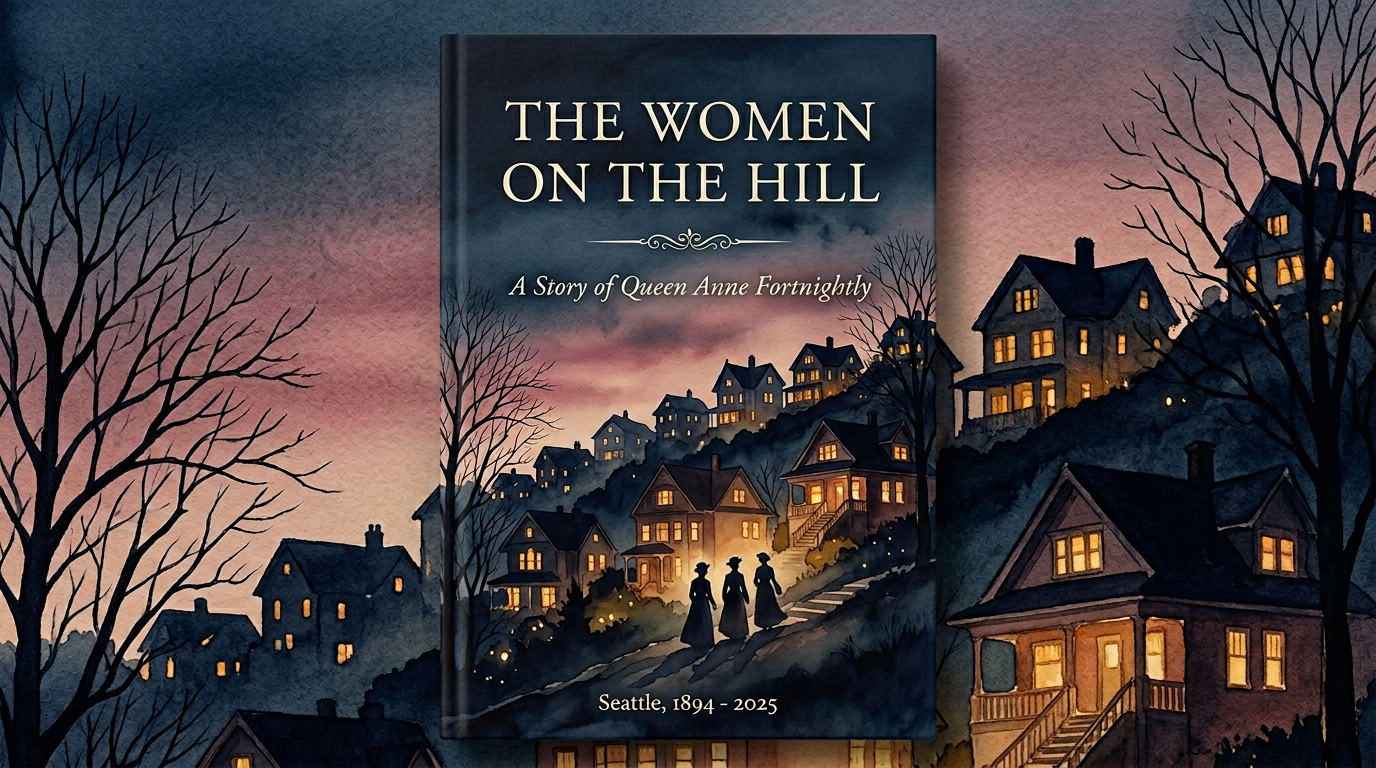
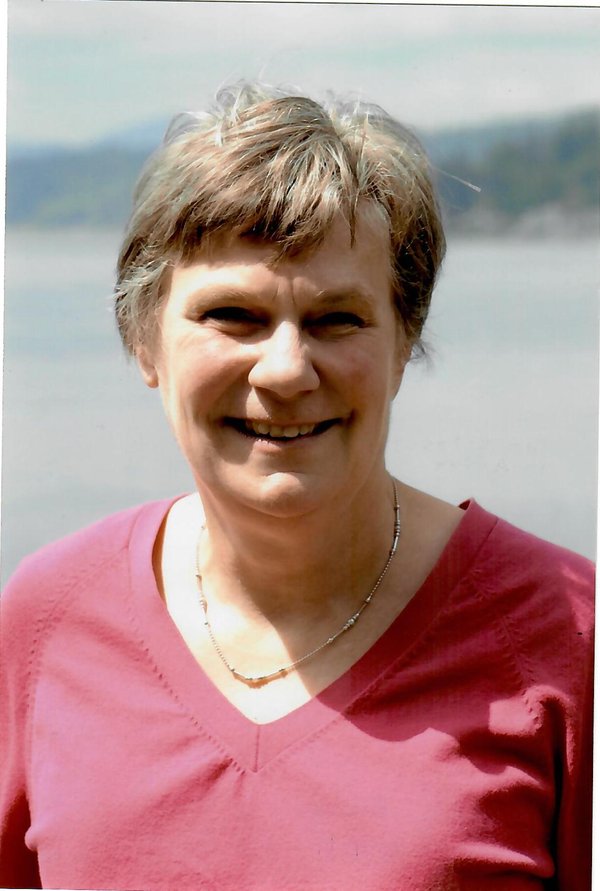
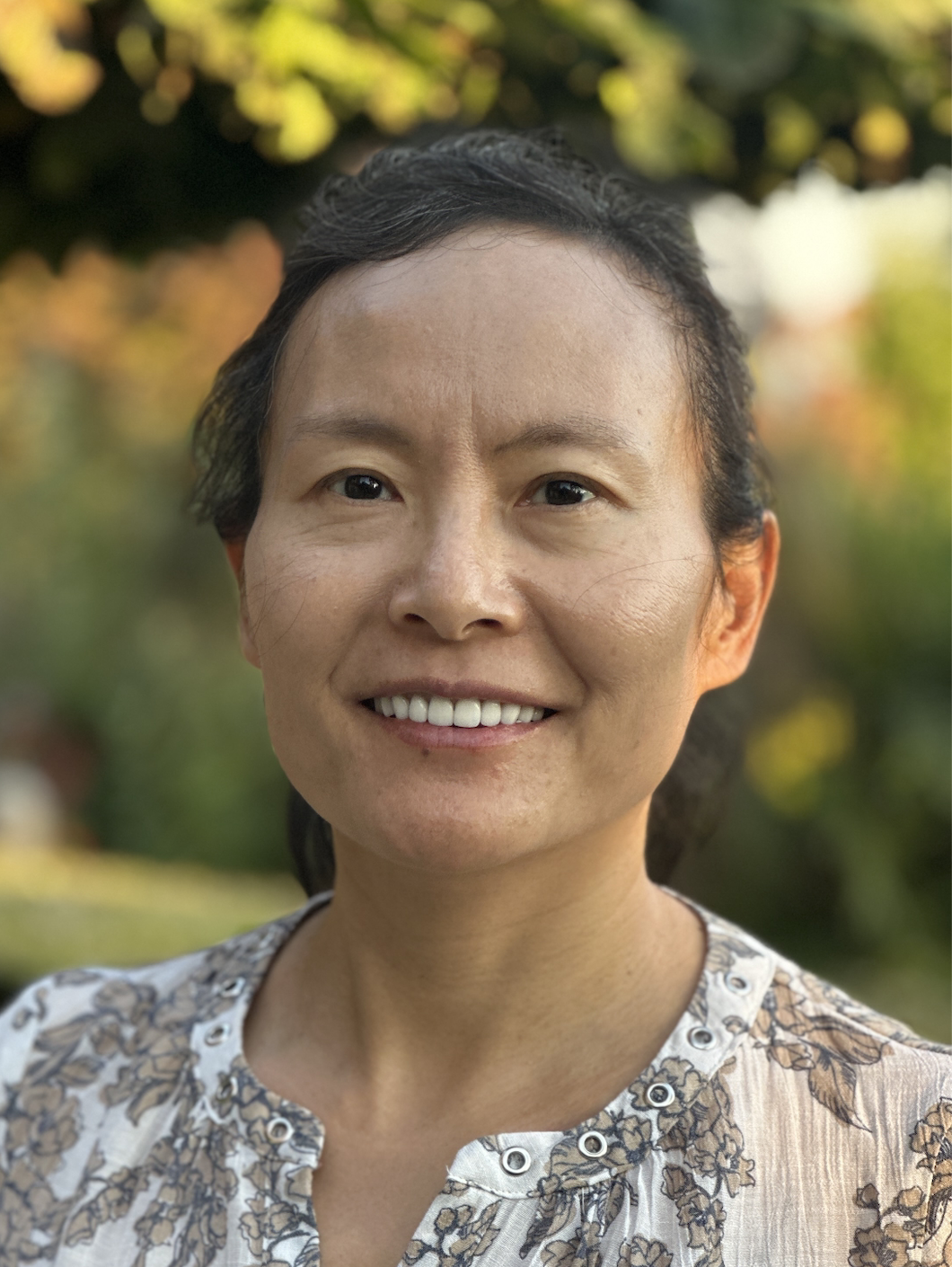
Andrew Conru is a Stanford-trained engineer, painter, and founder of the Conru Art Foundation. He built the world's first online dating site in 1994 and now creates public spaces for beauty, truth, and love in Seattle.
Woven from the papers, memories, and voices
of the women of the Queen Anne Fortnightly Club
Seattle, 1894–2025
Foreword
Why I Wrote This Book
I have such an affinity for Queen Anne.
I love looking at old photographs of places and people. I can stare at a picture from 1900 and imagine what that person's life was like, just from the details. The hat. The house behind them. The way they're standing. It's a miracle that we have any knowledge at all of the time before us. We know it existed because of the photos and the stories that were written down. Without those, it's gone.
My wife showed me the archive of the Queen Anne Fortnightly Club. Her neighbor is in the group, and I think she was hoping I could find a way to make the papers searchable for the ladies. The archive had more than 450 papers spanning 130 years, over a million words of text, and nobody was going to sit down and read all that. I read a few, and realized there was a lot in there. So I put AI to work reading all of it, and asked it to tell me what it found. What came back was interesting enough that I felt the best way to share it was this book.
I've attended a couple of the Fortnightly meetings. The women are interesting people. And these types of groups are fading away. There are fewer and fewer of them every year. We need more, not fewer. We need women getting together in rooms and talking to each other. We need neighbors who know each other's names. We need the kind of community that these twelve women built in 1894 with nothing but a parlor and twenty-five cents.
These stories are not about big historical events. They're about the little quiet moments. The raising of kids. The engagement with community. The fabric that makes a neighborhood into something worth belonging to. That's what's so important to preserve, and so easy to lose.
Every quote in this book is real. Every name is real. Every incident happened. The Author's Note that follows explains exactly how it was made, and the complete archive is published alongside the book so you can check anything against the women's own pages. They did the writing, over a hundred and thirty years. I did the gathering.
I hope you enjoy these stories. I hope one of them stays with you. And I hope, when it does, you send it to a friend.
Andrew Conru Seattle, 2026
For the women of the Queen Anne Fortnightly Club,
1894 to today —
and for the twelve who started it.
A Note on How This Was Made
Everything in this book is real. Every woman was real, every event happened, and every line in quotation marks is exactly what she wrote or said, taken from the club’s own archive. The complete archive is free at thewomenonthehill.com/archive, so you can check any quote against the original page.
AI did the reading at scale: it went through the million words and surfaced the stories most worth telling. In between the quotes, I sometimes fill in the picture: what the parlor smelled like, what the weather was, what a woman may have been thinking on her way up the hill. When you see words like perhaps or one imagines, that is the filling-in, grounded in what the women themselves recorded. The facts are theirs. The connective tissue is mine.
The book also does not skip over the parts of a 130-year record that are uncomfortable today. Those are told as plainly as everything else, because everything happened is only a promise if it includes them.
— A.C.
“My fondest wish is that I could be in Seattle on a meeting day and so attend one more meeting. Oh, well…one can dream.”
— Margaret Siegley, in a letter to the club, 1987, written with her original 1947 invitation to membership in her hand
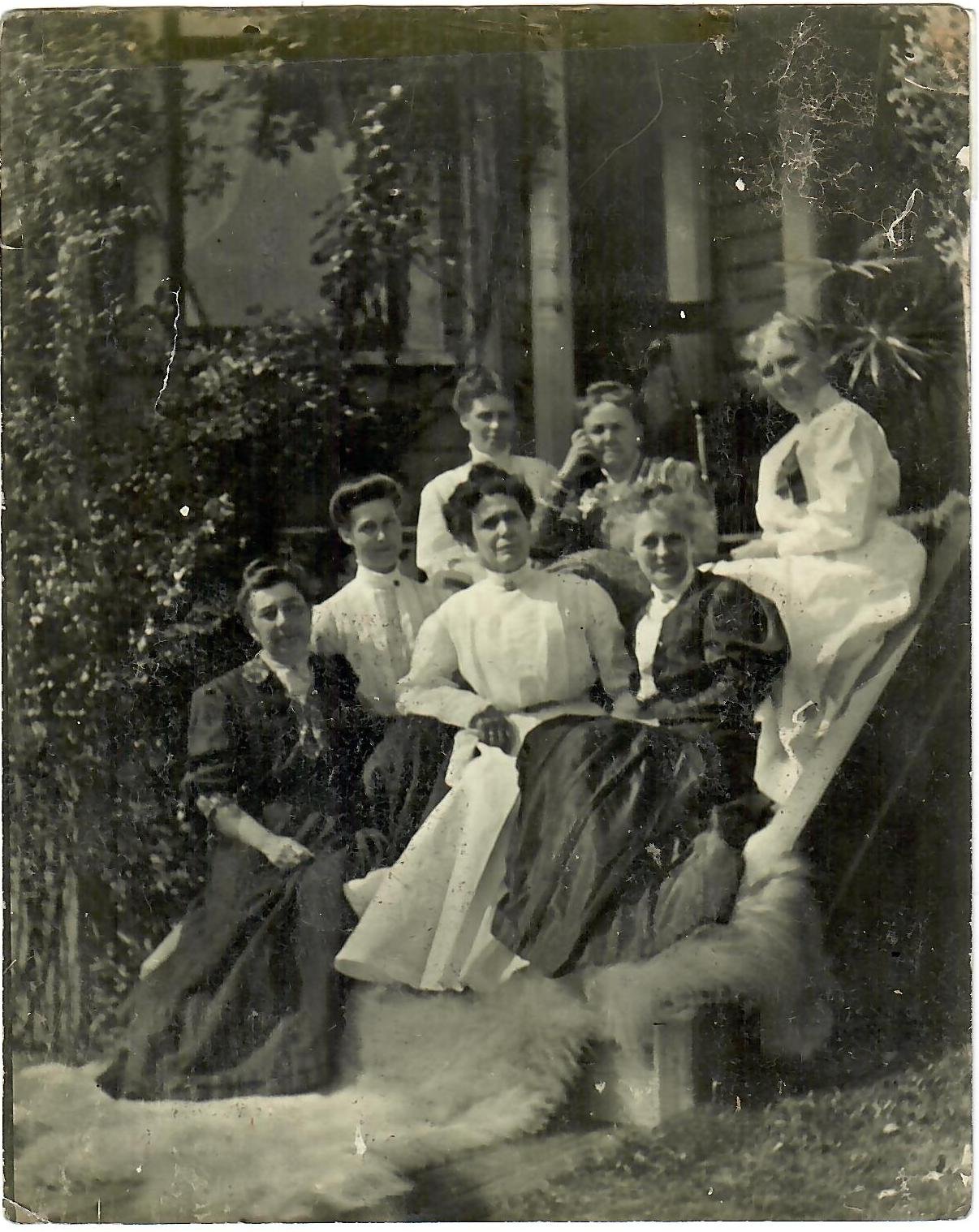
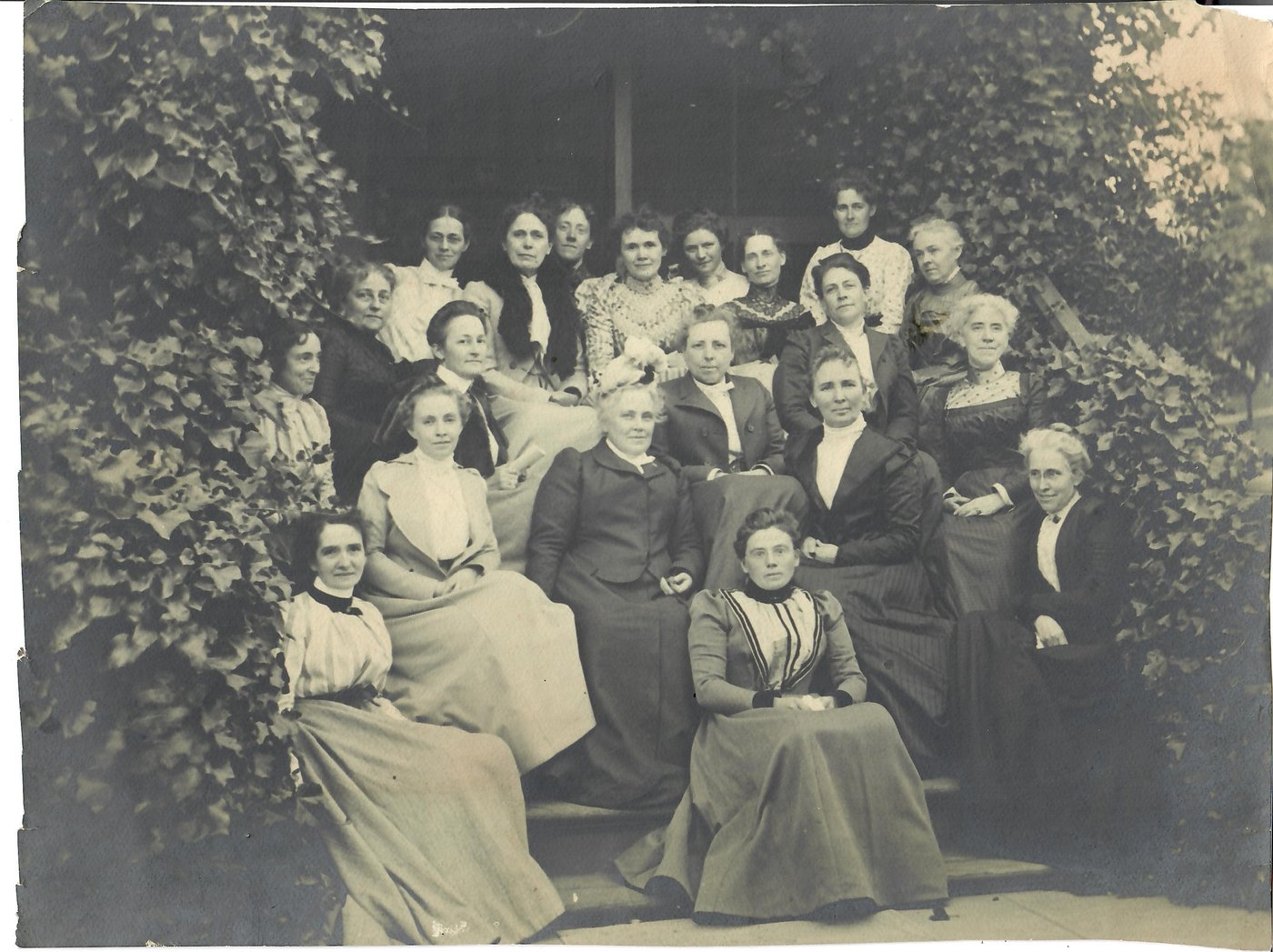
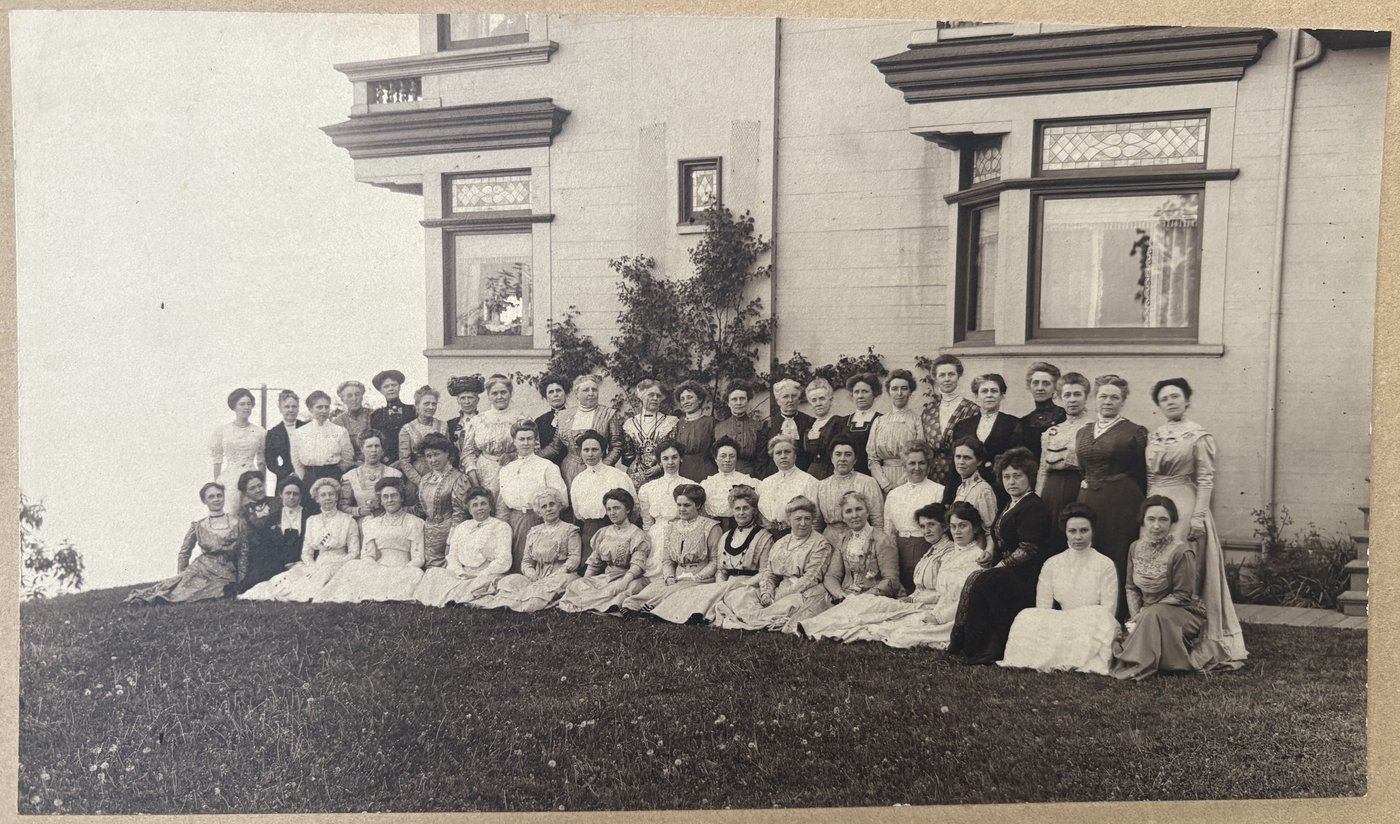
Charter members of the Queen Anne Fortnightly Club — Anna Sheafe, Molly Sackett, and Carrie Pike among them
You are walking up Queen Anne Hill.
It is September 20, 1894. The hill is wilder than you would expect. Second-growth forest presses in from both sides of the wooden sidewalks. Stumps from the original timber, barely rotted, break the lots between houses. The air smells of wet cedar and chimney smoke. A cable car is climbing the counterbalance somewhere behind you, working against the grade, and you can hear it: a long rasping groan at the limit of its cable, a sound that is the specific music of Seattle in 1894 and that will disappear entirely by 1940. At the top, on a clear afternoon like this one, you can see Mount Rainier floating above the skyline to the south, and Puget Sound laid out to the west, and the Olympics on the far shore in a single white row.
You are a woman in 1894.
You cannot vote. You have not been to university. The avenues of public intellectual life — the universities, the newspapers, the city clubs, the rooms where men decide things — are largely closed to you. Your husband, if you have one, comes home in the evening and expects his dinner on the table. Your children, if you have them, expect their scrapes attended to and their lessons heard. If you are lucky, you have time in the afternoon to read. If you are very lucky, you have friends who read the same books.
And there is a woman at the top of this hill who has been walking door to door for a week, asking a strange question.
A literary club, she has been saying. Meeting every two weeks. We would read papers to each other.
You said yes.
You don’t know exactly why. Maybe because she is serious and you are tired of not being taken seriously. Maybe because you have been lonely in a way that has no name. Maybe because the word fortnightly has a music you like. Maybe because twenty-five cents is a sum you can spare for annual dues, and even in 1894, you know that something you pay for is something that will be yours.
On the afternoon of September twentieth, you put on your hat. You walk up the hill. The wooden sidewalks are slick in places from the rain two nights earlier. Your shoes click on the boards. You pass the stumps and the half-built houses and the lots where wild salal and fern press in from both sides.
You arrive at the corner of Queen Anne Avenue and Prospect Street.
You ring the doorbell.
Anna Sheafe opens the door.
And because of that afternoon, and because of what the twelve of you decide to do together that day, a woman named Margaret Siegley — ninety-three years from now and far from Seattle — will sit in her kitchen and cry.
You do not know her yet. You never will. She has not been born.
But she is why you are here.
• • •
The woman who opens the door is forty-seven years old.
She is not tall. She has a strong face. She is wearing, on this particular afternoon, a green shawl that Molly Sackett’s young daughter — who is there too, underfoot somewhere — will one day remember, a lifetime later, as ugly. Behind her in the hall there is the faint smell of beeswax on polished wood and the thinner, stranger smell of a fire laid in the parlor grate but not yet lit. A clock ticks. The double parlor, through the arched entry, is set up with chairs pulled into a loose circle, a sideboard laid with cups and saucers, and — it will strike the other eleven women as they arrive, each in turn, all within about twenty minutes of each other — a particular air of expectation. Something is about to happen. None of them know what.
Anna Sheafe’s own house. Northwest corner of Queen Anne Avenue and Prospect. A Victorian with double parlors and a dining room and a library and a view of Puget Sound through the front window that, on clear afternoons, reduces Mount Rainier to a small visual habit: you stop seeing it the way you stop hearing the cable car. Inside, somewhere — she has moved through the house all morning in the particular way a hostess moves, checking and re-checking things that need no checking — there is her husband, Colonel Charles Sheafe, whose insurance firm is in the process of writing policies on half of Seattle, and who will, on this day, keep himself respectfully out of the front rooms. There are six children. Four boys, two girls. At some point during the morning, a cow that the family has been pasturing in the vacant lot west of the property has also, reportedly, needed to be moved.
She has been thinking about this afternoon for weeks.
She had been thinking about it longer than that. She had been thinking about it, really, since she had first understood what she was and what her life had been arranged to be. She had been born in 1847, in the last years of a country that still ran on slavery; she had come of age through the Civil War; she had married a man with a Civil War name and a determination to turn Seattle into money, and she had followed him into a city that, when she arrived, was a grid of stumps. She had borne six children. She had, in the language of her century, kept a home.
She was not idle. Women of her class in American cities in the 1890s were never idle in the sense that sentence usually means. But she was, in another sense, profoundly unused. She read fast and widely. She kept a commonplace book. She had thoughts about Sappho and thoughts about Turkey and thoughts about the Constitution, and she had, in the ordinary traffic of her day, almost no one to tell them to.
There were, in September of 1894, essentially three things a woman like Anna Sheafe could do with her intellectual life.
She could read alone in her parlor, which is what most of her contemporaries did, and consider the matter closed.
She could join one of the large civic federations just then taking shape in American cities. The General Federation of Women’s Clubs had organized itself at a national level in 1890. Seattle’s Women’s Century Club had followed. That path led to public lectures, to petitions, to the kind of organized women’s reform movement that would, two decades later, help win her the vote.
Or she could do a thing smaller and stranger.
She could organize twelve of her neighbors and begin, on her own authority, on no one’s program but her own, a club whose entire purpose was to read and write and listen to one another for the rest of their lives. No outside charter. No national affiliation. No public lectures. No reform mission. Just twelve women, in a parlor, every other Thursday, forever.
She chose the third option.
• • •
Ten years later, Carrie Pike — who had been there that afternoon, who had said yes — tried to describe what Anna Sheafe had done in the days leading up to September twentieth. She wrote:
Mrs. Sheafe was afterwards known as our Club Mother, for it was she who conceived and most earnestly pushed the idea — going from house to house, with temerity, at the thought of presenting any scheme to any woman which meant added work or responsibility.
The sentence is full of its century. With temerity. You do not need to translate. In 1894, in that city, in that decade, what a married woman of forty-seven was not supposed to propose to other married women was another claim on their time. Other women were busy. They had households. They had children. They had husbands who expected dinner. They had laundries that burned coal and mothers-in-law who needed visiting and teething babies and sick aunts and bread rising on the back of a stove. What Anna Sheafe was walking up to propose, in September of 1894, was that they give her a Thursday afternoon. Every other one. For the rest of their lives.
She did not walk alone. Her neighbor, a woman named Lydia Crockett, had thought the idea was good from the first and had gone with her — the two of them, on foot, going door to door across the flat top of the hill, making their small and radical case in every front room where it got them through the door.
By the end of the week, enough women had said yes that Anna Sheafe could set a date. Eight of them made it, that first Thursday. By the end of the month the roster had grown to about a dozen — how exactly the numbers settled across the first season is a thing the minutes themselves disagree on — but what the minutes do name, because six of the charter members would collect themselves thirteen years later to write a history of the first thirteen years, are the names on the page of that 1907 book: Sheafe, Miller, Pike, Blaine, Sackett, and Jennings. They were the six still left, by 1907, to do the writing. Of the other charter women, Mrs. Holman was dead by the summer of 1895; Mrs. Knox, who always wore purple, and whom the club’s records called a very fountain of wit and humor, had moved on at some point in between. Belle Stoughtenborough, May Rasor, and the rest of them kept the club going in the in-between.
They were not, in any of the senses later centuries would use the word, distinguished. They were lawyers’ wives and a physician’s wife and a congressman’s wife. They lived on Queen Anne Hill. They had already agreed, in 1894, to each other.
Within the first year a young woman named Anna Clise would join the roll — the 1895 yearbook already lists her taking the Current Events slot on a Greek-themed afternoon. She was not yet thirty. Her husband James would come to run the Chamber of Commerce. Her children were small. She had not yet lost her boy, and she had not yet learned what she would do after she lost him: call twenty-three friends into a parlor on this same hill, one January afternoon, and begin a children’s hospital. We will come back to her. For now she is a new member, answering to her name. The club is not yet a year old.
And on the afternoon of September twentieth, they walked up the hill, and walked into a parlor, and sat down in a loose circle of chairs, and — every one of them, in ways they could not yet have named — chose to belong to one another for the rest of their lives.
• • •
At three o’clock the meeting came to order.
We know, from Anna Sheafe’s own account written thirteen years later, that something in her knew, even then, that this afternoon would matter. She would write:
As I sit here, in another September day — as full of gorgeous glory as was that one, thirteen years ago — trying to think this all out, and write it down, I find my pen gave ideas. This day melted into that. The memory of all the intervening years fled. And again we are assembled in council!
She did not remember the minutes. She did not remember the resolutions. What she remembered — what thirteen years of intervening Thursdays did not scrub out of her — was the specific geography of twelve faces in a room.
How real it all seems — till I can see each dear one, just how she was dressed, where she sat, how she looked, and what she said.
This is what memory does when it decides that a thing has mattered. It keeps the texture and loses the business.
What they decided is preserved, though, because the secretary wrote it down.
They voted a name. Fortnightly. Meeting every two weeks.
They voted dues. Twenty-five cents per annum.
They elected Anna Sheafe president, pro tem — which meant provisionally, to be confirmed later. A week later they confirmed her. She would remain president for a dozen years after that, would build the ritual architecture of the club in those years, and would miss only four meetings across the entire span. Near the end of her long presidency she gave the club a gavel she had had carved from ivory on a trip to Alaska, presented at a picnic, and kept ever after in a small wooden box that traveled from host to host, meeting to meeting, for the rest of the club’s life.
They voted hours. Two to four. Every other Thursday. Those hours would be kept, with small wartime exceptions, for 130 years.
And they voted the thing that was the actual radical act of the afternoon: that every woman present would, over the course of a club year, prepare and deliver one paper, on a topic of her choice, to be followed by discussion from the floor. Any subject was permitted. No subject was required. Every woman was to be both speaker and audience. No one got to be only one or the other.
That was the whole architecture. It was not complicated. It was almost offensively modest.
A small group of women, in a front parlor, taking turns.
And yet this small thing was, in that city, in that decade, in the ordinary life of an ordinary middle-class American woman, a small and radical act. It was not a reading society, which had existed for a hundred years. It was not a salon, which required a patroness. It was not a church circle, which required a minister. What they had invented was a structure in which a woman’s voice was guaranteed, in rotation, in perpetuity, inside a room of her peers. Every one of them would speak. Every one of them would be listened to. Every one of them would come back in two weeks, and then two more, and then two more after that, and would keep coming back, Thursday after Thursday, until they were too old or too dead to continue.
They were inventing, on September 20, 1894, in a double parlor at the corner of Queen Anne Avenue and Prospect Street, a very small piece of public life.
They did not yet know what it would cost them, or what it would hold, or what it would survive.
• • •
Nine months later, the first of them was dead.
Mrs. Holman — we have her last name, her husband’s initial, not much else — died in June of 1895. She had been at the founding. She had been present at nine meetings. And then, without warning, the chair she had been sitting in two weeks before was empty.
The club had existed for nine months. It had not yet faced a single death. Its members were, most of them, in the prime of life — in their thirties, forties, fifties; none of them had yet watched each other get old. And now, suddenly, there was a missing chair.
In a large organization, a death is absorbed. It is a line in an annual report. In a group of twelve it is a reckoning. The first question any bereaved small institution has to ask itself — before it asks whether it will go on, before it asks what to do at the next meeting — is the question: are we still us without her?
Anna Sheafe wrote the minutes of that meeting. She wrote them as an obituary. We do not have the page. We have only the knowledge, from later accounts, that Mrs. Holman’s death was the first test of the club, and that the club passed.
It passed, in part, because of a woman named Alsora Fry.
• • •
Mrs. Alsora Fry was a physician’s wife. She was a member, by then, but not a loud one. She had joined in the first years. She had attended. She had read. She had listened. And in the fall of 1898 — four years in, after Mrs. Holman was gone and two other members had quietly dropped, after some of the women had begun to wonder, the way any group of adults in any decade of American life has periodically wondered, whether this whole thing was really going to last — she stood up at a meeting and read a short poem she had written about having joined Fortnightly.
The poem is funny on purpose.
It is also the reason the club did not end.
The die is cast. I now must think.
Forever more there must be ink
Upon my middle finger here;
And I must look so wise and queer,
With visage learnedly austere —
For I have joined Fortnightly.
A cyclopedia I must be;
A lexicon and history;
Authority on ages past;
On happenings the very last;
A walking X-ray, strangely cast —
For I have joined Fortnightly.
There are six stanzas. They promise, in mounting mock horror, that she must now become a searching anthropologist, a neat and trim geologist, a digger in philology, a savant in biology — all because she has joined Fortnightly. Alsora Fry was having fun. She was also doing something serious under the fun: naming out loud what none of the other women had yet said aloud.
The die is cast. We have done this. We are now a thing.
The casual assumption that a women’s literary club might last one year or two or three and then dissolve — the same assumption, honestly, that had folded a dozen similar clubs in Seattle in the early 1890s and would fold a dozen more in the 1900s and 1910s — was canceled, on a Thursday afternoon in a front parlor, by a small comic poem.
Alsora Fry had sat at the founding, and had sat through the first four years, and had looked around the room, and had counted, and had decided, four years in, that these twelve women were going to die members of this club.
Most of them did.
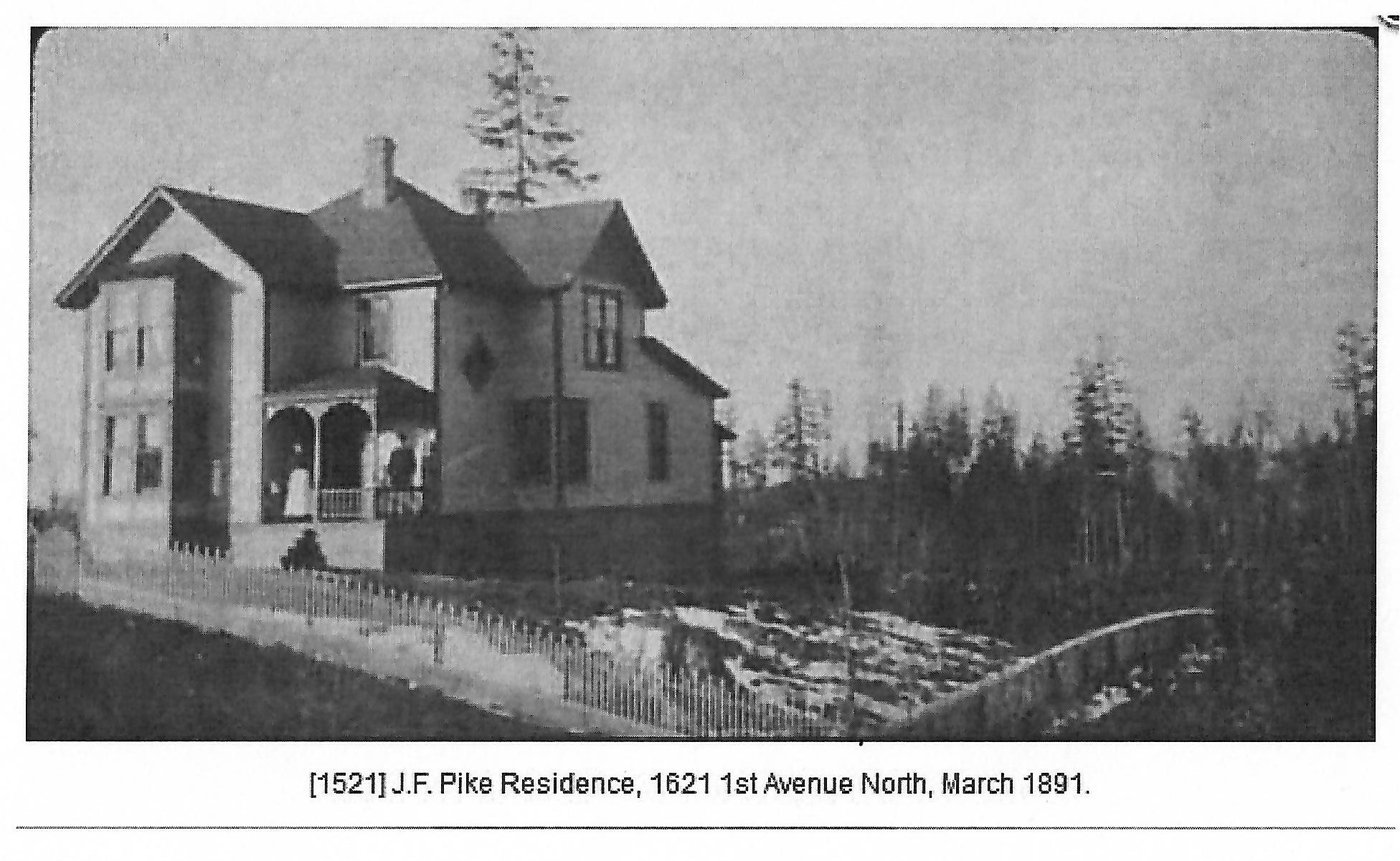
Mrs. Stoughtenborough, Mrs. Rasor, and Anna Sheafe herself would die within a single twelve-month of each other, a quarter century on, in 1919 and 1920. Carrie Pike would live for sixty more years, answering roll call into her nineties from a rocking chair in the front parlor of her house at 1621 First Avenue North, two blocks from where this afternoon began. Mrs. Blaine would stay a member for thirty-two years. Mrs. Sackett would become the grandmother of generations of club members.
The die, on a September afternoon in 1894, had been cast.
The club was now a thing that would outlive them.
It will outlive us too.
• • •
Chapter Two
The Night the Ceiling Fell
June 1896
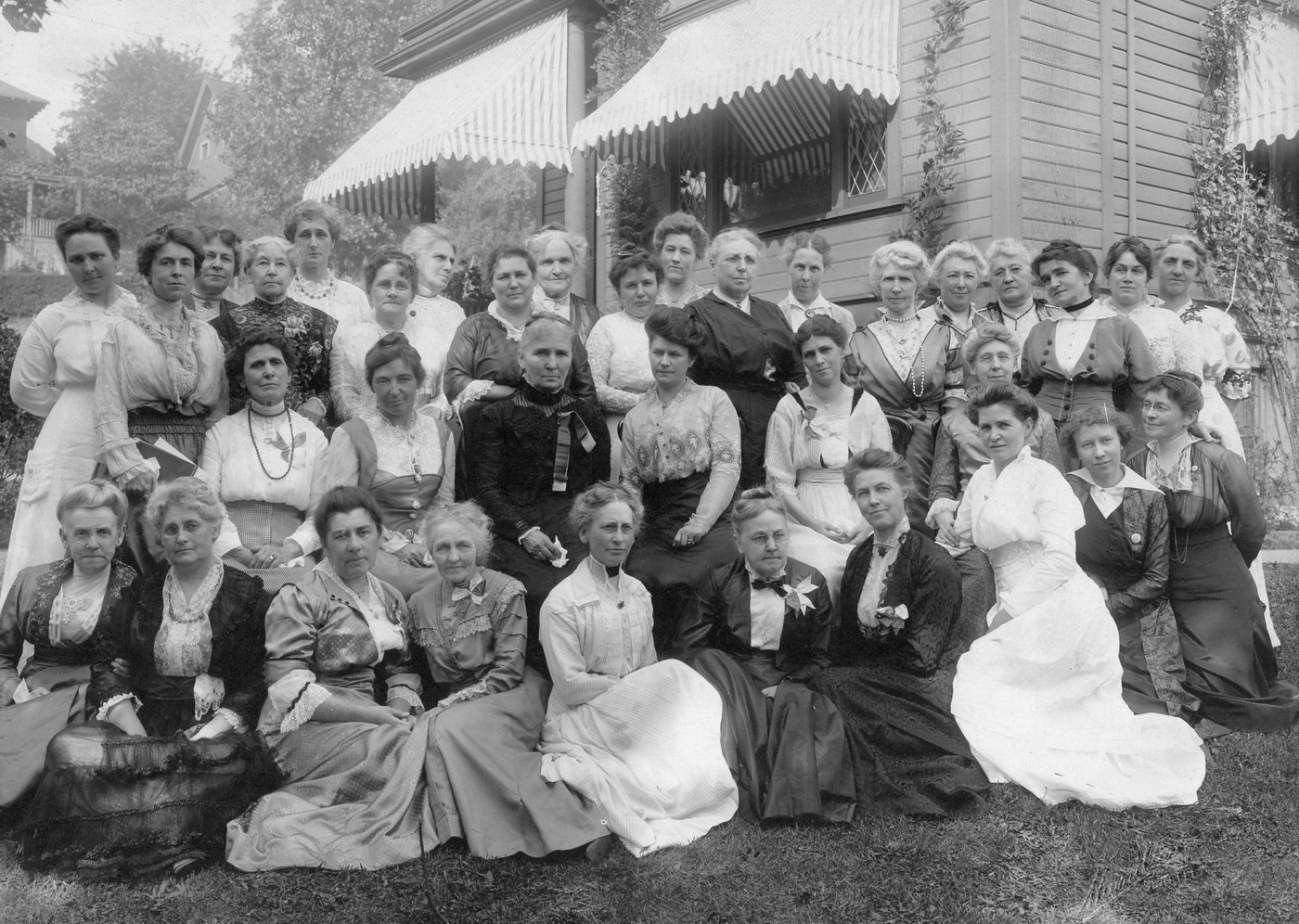
Members at Sheafe Home, 1900
Let us set the scene.
It is June 1896. The Queen Anne Fortnightly Club is two years old and feeling confident. They have survived the false prophets. They have studied their way through papers on Shakespeare and temperance and the political situation in the Balkans. They have eaten cake in each other’s parlors and debated the merits of various poets and generally proven that twelve women on a hill can sustain a program of intellectual self-improvement without anybody dying of boredom or murdering anyone over a disputed footnote.
And now they are about to do something daring. They are going to invite the husbands.
This was their first Gentlemen’s Evening, and they had planned it to within an inch of its life. You have to understand: these women had been studying parliamentary procedure and ancient history and the export economy of Japan, and they brought that same thoroughness to the question of how to entertain a room full of men who were probably expecting to be bored. The food was arranged. The decorations were up. The program was set. Everything was ready.
Picture the room before it all went wrong: the double parlors thrown open, gaslight softening every surface, heavy drapes pulled back to show the evening sky over the hill. The furniture was dark and solid. The air smelled of beeswax on polished wood, of cut flowers arranged on the mantel, of whatever was baking in the kitchen. This was what a Queen Anne parlor felt like in 1896: warm, enclosed, serious about comfort, a world built by women who understood that atmosphere was half the argument.
Then someone left the water running upstairs.
You can picture what happened next, because water and gravity are remorseless collaborators. The water spread across the upstairs floor, found the cracks, seeped into the plaster, and at some point, probably with a sound like God clearing His throat, the ceiling gave way. Plaster crashed down into the room where the party was supposed to happen. Chunks of it. Sheets of it. The kind of mess that makes you stand in the doorway with your hands on your face and wonder if you should just cancel everything and go to bed.
This is where Mrs. Cole entered the picture, and you need to remember her name, because Mrs. Cole is the reason this story has a happy ending instead of a humiliating one. The records describe her as “a real artist and general,” which is a combination you don’t see often enough. She looked at the devastated ceiling. She assessed the situation. And then she did what any real artist and general would do: she improvised.
Fish nets. Mrs. Cole sent someone to get fish nets.
They stretched the nets across the ruined ceiling, taut and even, and then they draped them with ferns. Green, cascading ferns, layered over the rough mesh of the nets, hiding the destruction underneath. When they were done, the room didn’t just look acceptable. It looked spectacular. It looked like something you would do on purpose. It looked like a grotto, a woodland bower, a fairy tale set in a Seattle parlor.
The husbands arrived. They looked up. They were dazzled. One gentleman guest was so moved by the intellectual firepower of the assembled company that he declared he doubted “if a like number of uncommonly intellectual people could be had from any other one section of the city.” He may have been talking about the conversation, but he was also standing under a ceiling made of fish nets and ferns, which suggests that the Fortnightly women had a talent for creating an atmosphere in which men said generous things.
Not all the husbands came to these evenings as fans. Some of them, the record quietly admits, had been dubious. A quarter-century later, in her 1919 retrospective, Alice Rayner would note with a dry turn of phrase that at the twenty-fifth-anniversary cafeteria dinner — Mrs. Blaine and Mrs. Bayley pouring, the dining room stacked with pies of every kind — “even husbands who had reported unfavorably on Club parties in general seemed to unbend completely.” The sentence is the only place in the archive where the women allow themselves to admit, in print, that some of their husbands had been skeptics all along. It is stated without a trace of grievance, and with the particular smile a hostess wears when an argument she has been winning for twenty-five years finally concedes over a second piece of lemon pie.
Nobody told the husbands about the plaster. Or if they did, it only added to the legend. Either way, the first Gentlemen’s Evening was a triumph, and Mrs. Cole became the kind of club hero whose name gets mentioned at anniversary dinners for decades to come. She saw a catastrophe. She turned it into a party. If that isn’t the story of the Fortnightly in miniature, nothing is.
• • •
But the Gentlemen’s Evening was only one of their social adventures. These women knew how to throw a gathering, and they brought to their parties the same fearless energy they brought to their papers on the Peloponnesian War.
And here this book has to stop and tell you about one of those parties plainly, because the promise on the first page of this book is that everything in it happened, and that promise is worthless if it only covers the parts that are easy to love. Around 1901, at Mrs. Parker’s house, the club staged a minstrel show. Fifteen of the ladies performed in white skirts and coats, the club history records, with blackened faces, or masks. The club’s sons, in the history’s own words, dressed up as real colored waiters and served the supper. The account, written in 1947, remembers it as one of the funniest nights the club ever had — the husbands trying to guess which blackface performer was their own wife. Molly Sackett, in 1904, called it a most wonderful Minstrel show.
No one in the record pauses over it. That is the point of including it. These were women of their time and their class, in a city and a country where blackface was parlor entertainment for white families who thought of themselves — accurately, in every other respect this book records — as decent, warm, generous people. The club was white. The hill was, by design of deed and covenant, overwhelmingly white. The women who cooked for some of these houses and cleaned them appear in the archive rarely, glancingly, and almost never by name. A book that celebrates what these women preserved owes the reader one honest look at what they never thought to question — and at who is missing from a million words of record. You will not find an apology for them here, and not an excuse either. Just the fact, kept the way they kept everything, because it happened, and the promise holds.
Consider, then — with the whole picture in view — the surprise farewell.
One of their members was moving away, and the club decided to give her a proper send-off. They arranged to meet at a member’s home, but when the guest of honor arrived, the house was dark. Completely dark. No candles, no lamps, nothing. She walked into the blackness, probably feeling her way along the hall, and then, from every corner, every doorway, every shadow, the women of the Fortnightly materialized. They swooped out of the darkness into formation, launched into a grand march, and swept their startled guest into a party that, the records note, “broke up in the wee sma’.”
The wee sma’. That’s a Scottish phrase for the wee small hours, the time after midnight when respectable people are supposed to be asleep. But nobody worried about getting home, because everybody lived on the hill. No streetcars to catch. No long rides through dark streets. You just put on your coat, stepped out into the night air, and walked home under the stars, maybe still humming whatever song they’d been singing at the end, your shoes clicking on the wooden sidewalks of Queen Anne.
This is the gift the hill gave them. It gave them the freedom to stay late. It gave them the freedom to be reckless with their evenings, to let a party run past all reasonable hours, because home was never more than a few blocks away. The geography of Queen Anne was the geography of intimacy, and the Fortnightly women used every inch of it.
• • •
Then there was the picnic.
The details are glorious and chaotic. They had set up outdoors, as one does for a picnic, with tables and food and all the trappings of a civilized meal in the open air. Somewhere in the middle of things, the table collapsed. Not a leg wobbling. Not a gentle tilt. The table went down, and the food went with it, and suddenly a group of women who could discourse on Elizabethan drama and the tariff question were standing in a field staring at potato salad on the ground.
But this was Seattle, and this was the Fortnightly, so what happened next was a boat ride. The details are hazy on exactly how the picnic became a boat ride, perhaps it had been planned all along, or perhaps someone had access to a boat and suggested it as a remedy for collective indignity, but they ended up on the water, gliding home by moonlight. The table had collapsed. The food was ruined. And now they were floating across the dark water with the moon laying a silver path before them, and everything was perfect. Some of the best moments in the Fortnightly’s history happened when the plan fell apart and something better took its place.
Puget Sound in the 1890s was the highway, the real one, the one that mattered. The Mosquito Fleet, dozens of small steamers, buzzed between every port and landing on the water, carrying mail and freight and people who thought nothing of crossing the Sound for an afternoon visit. The boats ran on schedules that everyone knew by heart, their whistles punctuating the day like church bells. A moonlit boat ride home was not an extravagance. It was simply the most beautiful version of an ordinary trip.
• • •
And then, because these stories seem to come in clusters, each one more improbable than the last, there was the progressive dinner in the rain.
A progressive dinner, for the uninitiated, is a party on the move. You have appetizers at one house, soup at another, the main course somewhere else, and dessert at a fourth. It is a logistical challenge under the best of circumstances, and in Seattle, where the rain can arrive sideways and without warning, it is an act of defiant optimism.
It rained. Of course it rained. It rained on the appetizers and the soup course and the walk between houses, and every member of the party got progressively wetter as the evening progressed. But Mrs. McBride had a plan, or rather, she had an instinct, which is better than a plan because a plan can go wrong and an instinct just keeps adapting. Somewhere between courses, she turned the soggy procession into a real estate tour of Queen Anne Hill.
Think about this. A dozen drenched women, stomachs half full, rain streaming off their hats and down the backs of their necks, and Mrs. McBride is pointing out lots and houses and properties with the relentless enthusiasm of a woman who knows her neighborhood down to the last fence post. Here is where the Hendersons built. There is the lot that went for such-and-such a price. Look at that view, you can see the whole Sound on a clear day, not that today is a clear day, but imagine it. The women followed her through the rain, laughing, soaked, learning things about their own hill that they hadn’t known before.
This is what the Fortnightly did to an ordinary evening. They took a dinner party and turned it into an expedition. They took a rainstorm and turned it into an education. They took a collapsed table and turned it into a moonlit boat ride. They took a ruined ceiling and turned it into a bower of ferns.
The pattern is clear if you look at it from above, the way you might look at Queen Anne Hill from a boat on the Sound. These women did not merely cope with disaster. They alchemized it. They had a talent for taking the things that went wrong, the water damage, the weather, the broken furniture, the darkness of an unlit house, and making them into stories worth telling. Worth telling at the next meeting, worth telling to the husbands, worth telling at the fiftieth anniversary and the sixtieth and the hundredth.
The fish nets are gone now. The ferns dried and crumbled a long time ago. Mrs. Cole’s name has faded from general memory. But the principle she established on that June evening in 1896, that a Fortnightly woman does not cancel the party when the ceiling falls; she builds a better ceiling, that principle is woven into the DNA of the club.
It is, you might say, the Fortnightly way.
You take what falls on you, and you cover it with something beautiful, and you invite people in, and you stay until the wee sma’, and then you walk home in the dark, up the hill, under the stars, because you live here, all of you, together, on this steep and stubborn piece of ground.
“Weight: 12 members with comely faces and good healthy brains.”
Pike, 60th QAFC Anniversary, 1954
Carrie Pike had a sense of humor that could fit in a thimble and still have room to rattle around, which is to say it was small and precise and sharp as a pin. When she sat down to write the club’s history, she did not write a history. She wrote a baby diary.
“Born September 20th, 1894. Weight: 12 members with comely faces and good healthy brains.”
Just like that, with one stroke, the Queen Anne Fortnightly Club was no longer an organization. It was a child. It had a birthday. It had a weight, measured not in pounds but in faces and brains. And Carrie Pike was going to record its growth year by year, the way a doting mother marks the first tooth and the first step and the first word, except that instead of teeth and steps, this baby had yearbooks and study programs and an expanding membership roll.
The dresses, Pike called the yearbooks. Because what else would you call the little printed booklets that told you what the club would study that year and who would present and when? They were the club’s wardrobe, its public face, the thing you showed to visitors when they asked what the Fortnightly was all about. The baby’s first dress. Then a new one every year, each a little more elaborate than the last.
The strenuous exercise came next. In one of its early years, the club’s program called for the study of fifteen countries. Fifteen. In the space of a single season of fortnightly meetings. That meant a new country roughly every meeting, which meant that every two weeks some woman had to stand up in a parlor and deliver a comprehensive paper on a nation she probably could not have located on a map six weeks earlier. Spain one week. Siam the next. Then perhaps Argentina, or the Ottoman Empire, or Japan.
Pike recorded this with the dry amusement of someone who had probably been assigned three of the fifteen countries herself. Strenuous exercise, she called it, and you can hear the wry smile. These were women who were raising children and managing households and navigating the thousand small crises of domestic life in a city that still had wooden sidewalks, and in their spare time they were delivering papers on the political economy of Peru.
But Pike’s baby diary had a postscript, and the postscript had a heart. She wrote about “the good mother”, Anna Sheafe, the founding spirit who had gathered the original twelve and set the whole thing in motion. The good mother. Not the president, not the founder, not the chairwoman. The mother. Pike understood that what Anna Sheafe had created was not just an organization but a family, and that the metaphor of the baby was not really a metaphor at all. The Fortnightly was something that had been born, and it needed tending, and someone had to love it fiercely enough to keep it alive through the early years when everyone said it would die.
• • •
The baby did not die. But something happened in June 1895, not even a year after the founding, that cast the first real shadow across the club’s bright beginning. Mrs. Holman died.
The records do not linger on the details. There is no account of the illness, if there was an illness, or the accident, if it was an accident. What there is, in the spare and formal language of the minutes, is the fact of the loss. Mrs. Holman, one of their own, was gone. Suddenly. In June, which is supposed to be the gentlest month in Seattle, when the rain finally relents and the rhododendrons bloom and the light lasts until ten o’clock at night. In June, Mrs. Holman died.
The club was nine months old. Still a baby, by Carrie Pike’s reckoning. And already it had to learn the thing that all living things eventually learn, which is that the circle does not stay whole. People leave it. Sometimes they leave it forever.
The Fortnightly absorbed the loss the way it absorbed everything: by continuing. They met. They studied. They presented their papers and ate their refreshments and argued about the Romantics and the realists and whether Browning was as good as Tennyson. They did not let grief become an excuse to stop doing the thing they had come together to do. This was not callousness. It was conviction. Anna Sheafe’s good mothering had given the baby a spine.
• • •
Meanwhile, the question of who could join the club, and who could not, was becoming a matter of some delicacy. The unwritten rule was clear: you had to live on Queen Anne Hill. This was the founding principle, the geographic bedrock on which everything else was built. But rules, even unwritten ones, sometimes bend.
There came a moment when the club relaxed its boundary. They let in two women who lived, well, not exactly on the hill. Near it, perhaps. In the general vicinity. The records are vague about the geography, but the result was clear: the club gained two members. For a time, this seemed like a fine idea. More voices. More perspectives. More women to share the burden of fifteen countries in a single year.
Then they snapped the rule back into place.
Why? The records don’t say, or rather they say it with the tactful silence that organizations use when they don’t want to name names or air grievances. But you can guess. Either the off-hill members couldn’t come regularly, the streetcar problem, the distance problem, the it’s-raining-and-I-live-in-Fremont problem, or the on-hill members decided that the thing that made the Fortnightly special was precisely its rootedness in one place. You couldn’t be a neighborhood club if you weren’t a neighborhood. The exception was tried. The exception was retired. Queen Anne Hill remained the price of admission.
• • •
And here is a thing the baby did before it turned six, which almost nobody in Seattle knows.
The minutes of September 7, 1899, written by Mrs. Sophia Fisher, record it plainly: “It was said that the Fortnightly Club was intended to be no less philanthropic and charitable than it was literary. The first mention anywhere made of the need of a city ambulance was made by this Club. Mrs. Samuel Crockett put before the meeting the great need in Seattle of a city ambulance. She worked thru the City Federation and took the matter up with the City Council. While it was slow in coming, owing to the expense, it was finally accomplished.”
Read the claim in that minute: the first mention anywhere. The first recorded call for a city ambulance in Seattle was made not by a hospital board, not by the city council, not by a newspaper campaign — but by a woman standing up at a meeting of a five-year-old ladies’ literary club in a parlor on Queen Anne Hill. And then Mrs. Crockett did what the women of this club did when they had decided a thing should exist: she worked it, meeting by meeting, through the Federation, to the Council, until the city bought the ambulance. Slow in coming, owing to the expense. Finally accomplished.
Three months later, in December of 1899, the same young club spent an afternoon debating what the papers of the day called the New Woman. The minutes preserve the room’s conclusion, and it was not a radical one: the general impression, the secretary recorded, was “that woman should be contented with her sphere as wife and mother and not to strive to become man’s equal in places where nature had placed her at a disadvantage.” These were not revolutionaries. And then the minute adds this: “Then Mrs. Sackett made the happy remark that while in the act of leaving her home for the Fortnightly Club, she gazed around at her well-regulated house and thought that clubs took nothing from the thoughtful care of her house.”
There she is again — Molly Sackett, who will read the fireplace paper eighteen years from now — slipping the whole debate into her handbag on the way out the door. The room said a woman’s place was her home. Molly Sackett looked around her home, found it in excellent order, and went to her club. Both things were true. That was the whole trick of the Fortnightly, stated in one minute in 1899: they never asked the century’s permission, and they never announced the revolution either. They just kept the house well-regulated and kept walking out the door — and occasionally, on the way, they got the city its first ambulance.
• • •
And Carrie Pike remained at 1621 First Avenue North.
She lived there for fifty-nine years. Think about that number. Fifty-nine years in the same house, on the same street, on the same hill. She watched Queen Anne transform from a muddy outpost of wooden houses and plank sidewalks into a proper urban neighborhood with paved streets and brick apartment buildings and a view of the Space Needle that hadn’t existed for most of her life. She watched the streetcars come and go. She watched automobiles replace horses. She watched two world wars flicker across the front pages of the Seattle papers that were delivered to her door at 1621 First Avenue North, where she was always home, because where else would she be?
From that window at 1621 First Avenue North, Pike would have heard the stampeders headed for the Klondike in 1897, their boots and dreams clattering down toward the waterfront. She would have seen the Alaska-Yukon-Pacific Exposition of 1909 draw the world’s attention to Seattle, transforming the university grounds into a gleaming White City. She would have watched the streetcar tracks get torn up and the electric buses strung along the overhead wires that still crisscross the hill today. And in 1962, when she was already very old, she would have watched the Space Needle rise on the skyline to the south, a strange new punctuation mark on the city she had known since it was barely a city at all.
The club these women kept ran on such telephones, and on the small unhurried courtesies that traveled down the wires. Margaret Gray, in her memoir of the early members, tells of Charlotte Reed — a member from 1916, tall, very handsome and regal looking, whose dignified carriage had always intimidated her — taking notes from her one day over the telephone. Mid-sentence, Mrs. Reed stopped and said: “Wait a minute until I sharpen my pencil. It won’t write good.” “After that,” Gray wrote, “I felt much more at ease with her.” It is the whole social physics of the club in one sentence: the most regal woman on Olympic Place, undone and humanized by a dull pencil.
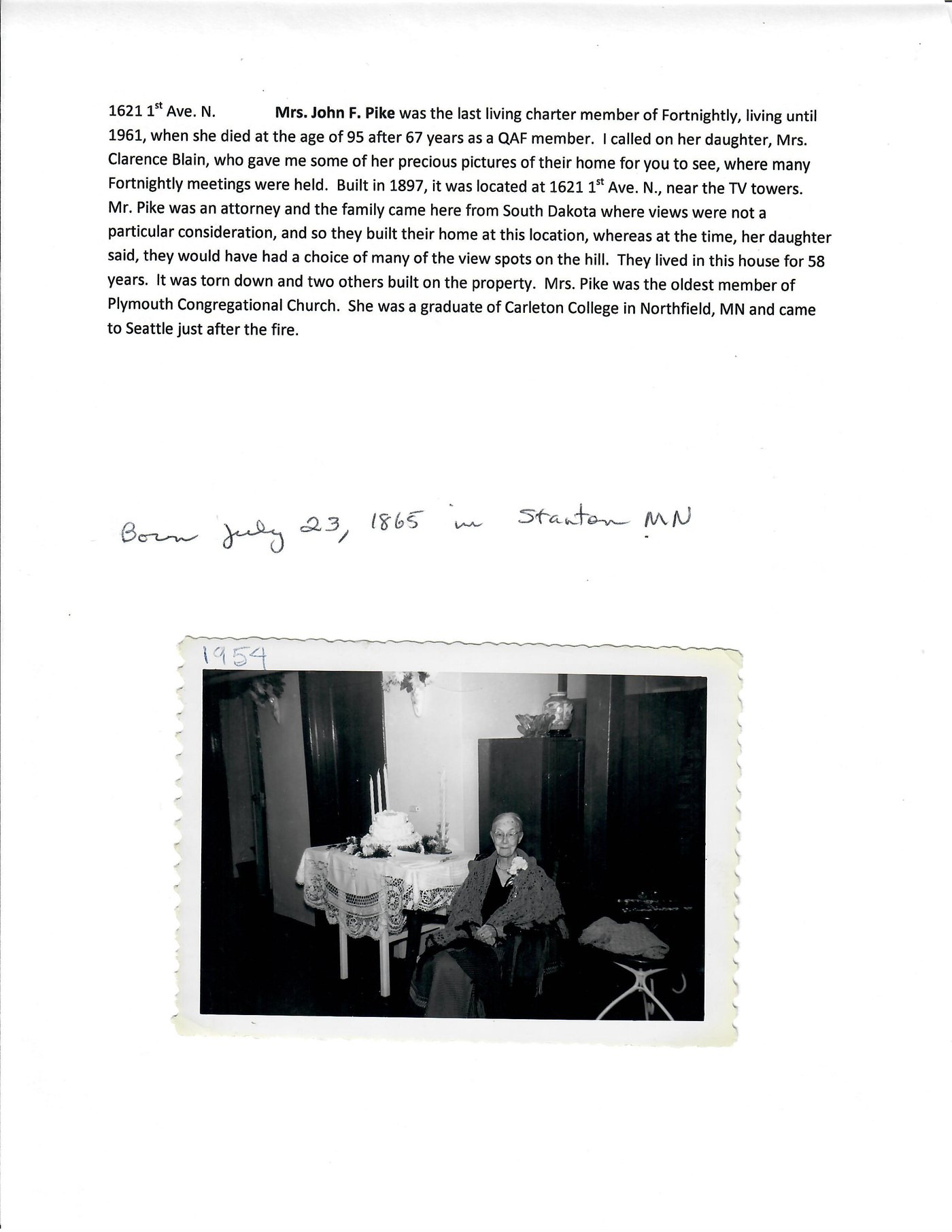
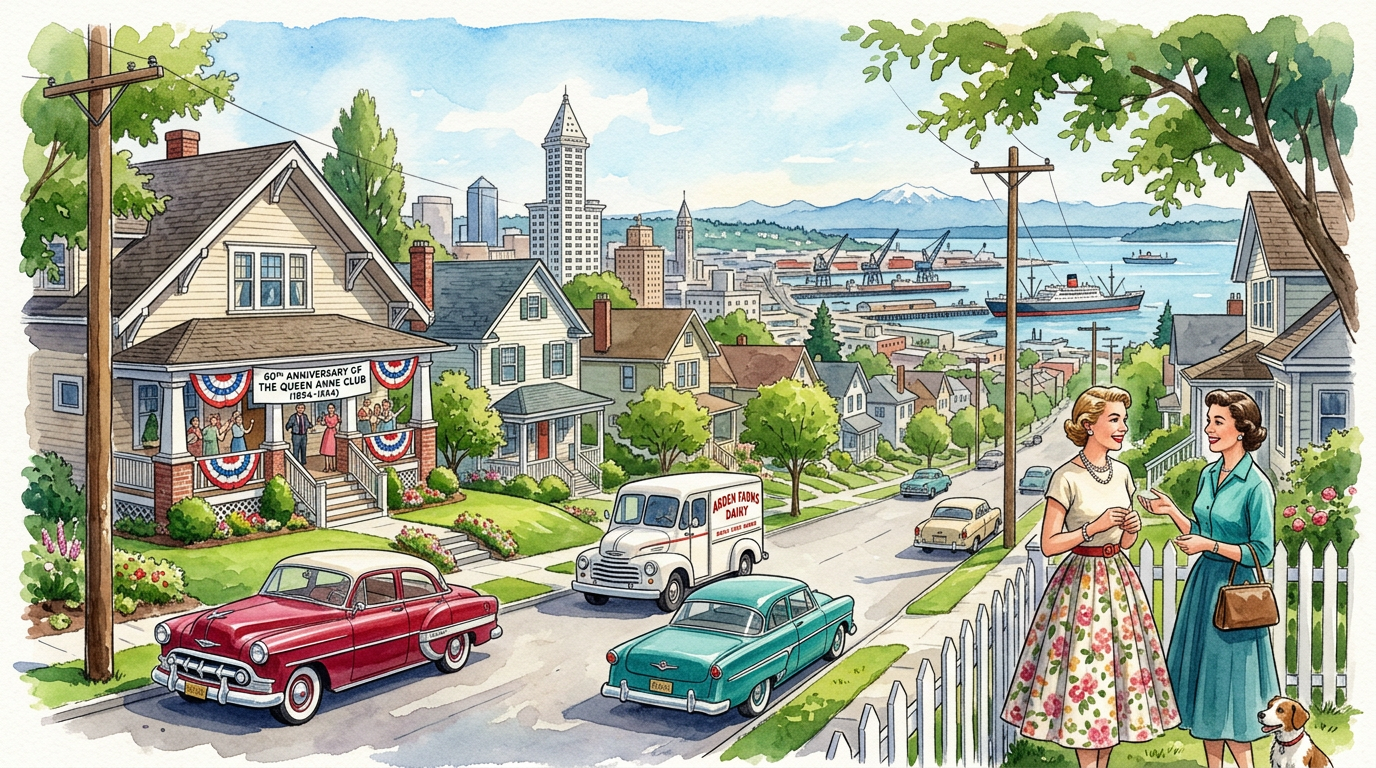
In 1954, the Queen Anne Fortnightly Club celebrated its sixtieth anniversary. Sixty years. Twelve presidents had served. Hundreds of papers had been read. The study programs had ranged across every continent and most of the centuries. The baby was sixty years old, and still kicking.
They held a dinner. A proper one, with toasts and reminiscences and the particular electricity that gathers in a room when women who have known each other for decades come together to celebrate the fact that they are still here, still thinking, still meeting every two weeks.
Carrie Pike was there.
She was ninety years old. She sat in a rocking chair, because at ninety you have earned the right to a rocking chair at any gathering you attend. Her hair was white. Her eyes were clear. And when it came time for roll call, that old ritual, that fortnightly rite of women answering to their names, Carrie Pike answered hers.
She didn’t just say “present.” She made references. Clear, sharp, specific references to things that had happened decades earlier. The baby’s first dress. The strenuous exercise of fifteen countries. The good mother. She remembered it all. She could reach back across sixty years of Fortnightly meetings and pull out a detail the way a magician pulls a coin from behind your ear, and the room, every woman in that room, thrilled.
That is the word the records use. Thrilled. “The whole room thrills with joy in the privilege of knowing her.” Not admiration. Not respect. Joy. These women were joyful to know Carrie Pike, to be in a room with someone who had been there from nearly the beginning and could still tell you what it was like.
There is something about living in one place for fifty-nine years and belonging to one club for sixty that creates a kind of authority no résumé can match. Carrie Pike had not climbed a corporate ladder. She had not run for office. She had not done any of the things that the world generally recognizes as achievement. What she had done was stay. She had stayed in her house. She had stayed in her club. She had stayed on her hill. And in the staying, she had become something irreplaceable: a living memory.
Every organization needs a Carrie Pike. Someone who can look at the newest member and say, I was here before the streets were paved. Someone who holds the thread that connects the present to the past, not in a dusty, archival way, but in a breathing, laughing, rocking-chair-at-the-anniversary-dinner way. Without that thread, a club is just a club. With it, a club is a story, and the story goes all the way back to a baby born on September 20th, 1894, weighing twelve members with comely faces and good healthy brains.
Carrie Pike sat in her rocking chair, and the room thrilled around her, and outside the windows of wherever they were gathered, Queen Anne Hill did what it always does. It held its ground. It rose above the city. It kept its people close.
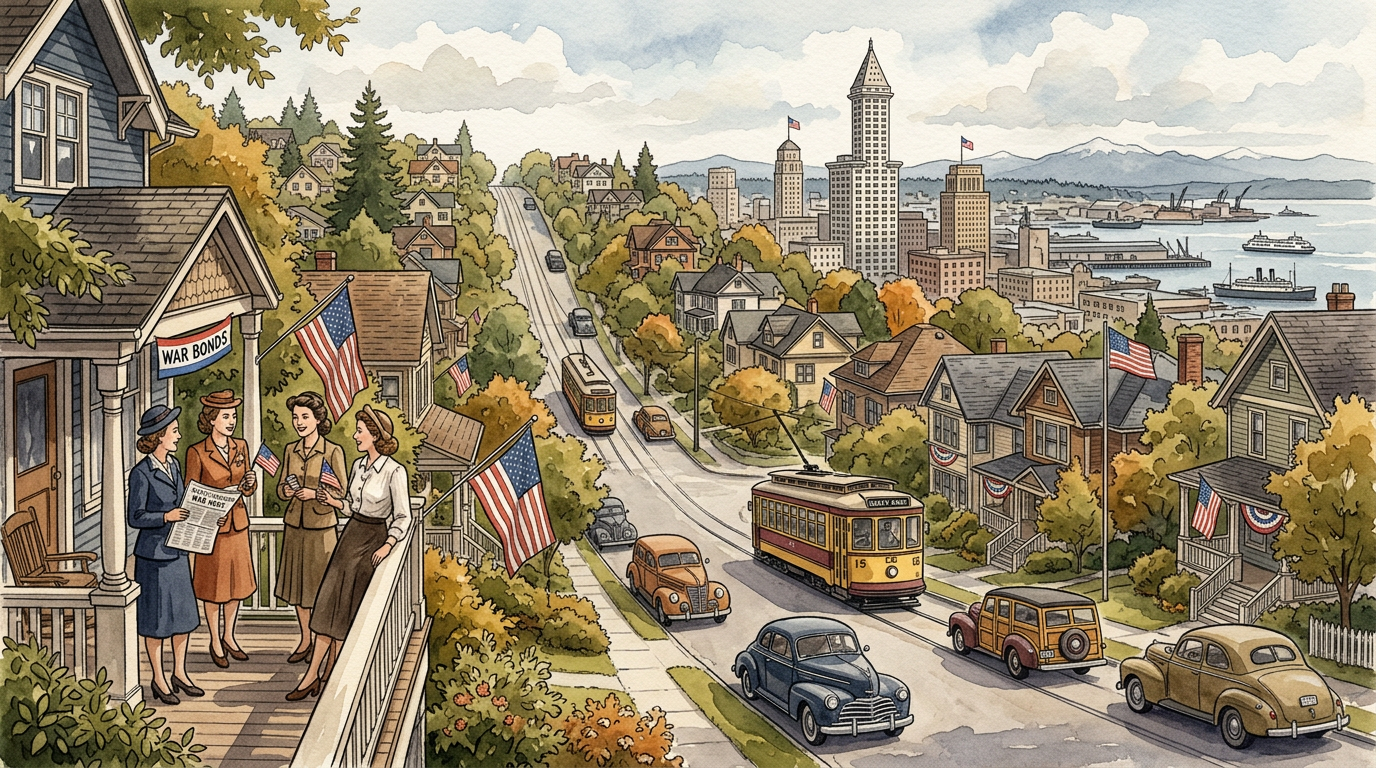
It is not raining, but it has rained in the night, and the wooden sidewalks up Highland Drive are still slick in their low places. The sky over Puget Sound is the color of wet slate. The temperature at noon, according to the Seattle Daily Times of that morning, is in the middle forties. Somewhere in the paper, near the foreign news, there is a headline about a British merchantman sunk off the Irish coast by a German submarine — the twentieth in a month — and somewhere further in, there is the first American report of the intercepted cable that will come to be called the Zimmermann telegram. America is not yet at war. America will be at war in six weeks.
The Queen Anne Fortnightly Club does not know any of this. The Queen Anne Fortnightly Club knows that it is Thursday, February the twenty-second, Open Day, and that the hostess today is Mrs. Howard Joslyn, who is Anna Sheafe’s daughter Lois, and that there are two papers on the program, and that each member has brought one guest.
A woman is walking up the hill.
Let us say, for the sake of this chapter — because the archive does not preserve which woman, on this particular Thursday, arrived in which order or along which street — let us say it is Mrs. Sackett. Molly Sackett. She is fifty-seven years old. She is a charter member. She has been coming to Fortnightly every other Thursday afternoon for twenty-three years. She has been preparing today’s first paper for three weeks. It is about her grandfather’s fireplace.
She has it under her arm in a leather folder.
Inside the folder is a paper of twenty to twenty-five minutes’ reading time — the manuscript itself says so, in a note at the top. She wrote it the year before, in 1916. It is a true story of something that happened almost fifty years earlier: a small girl’s winter visit to her grandfather’s farmhouse in Indiana, told fireplace by fireplace. One imagines she has read it aloud at home at least once before risking it on the club; one imagines her daughter Margaret, twenty-five that winter, has already heard the part about the covered bridge.
Mrs. Sackett is not afraid to read it in public. She has been reading her papers to this group for twenty-three years. What she is thinking, walking up the hill with the leather folder under her arm and a small pink carnation pinned to her coat, is something closer to: I hope the children behave. I hope Mrs. Pike remembers to bring the ode on the coffee pot. I wish it would stop drizzling.
She turns off Queen Anne Avenue onto Highland Drive.
• • •
The Joslyn house is a gabled Colonial Revival on the flat top of the hill. The sidewalk curves around the foot of the garden wall. There is a pink carnation in a silver pin by the doorbell — a small signal from the hostess, since February, that the club colors are still pink and green and that this is the afternoon the club will come through the door. Mrs. Sackett rings.
Lois Joslyn answers.
Lois Joslyn is thirty-nine. She is her mother’s daughter. Her mother, Anna Sheafe, the founder of the club, is still alive — still a member, though now an associate one, seventy years old, semi-retired, traveling more often to Vienna where her sister studies piano. Anna Sheafe will be in the room this afternoon. The founding women are already moving, by 1917, into the part of their lives where their own daughters hand them their tea.
Mrs. Joslyn takes Mrs. Sackett’s coat. She takes her hat, and pins it, on a small cloth form in the coat bedroom upstairs, next to five hats already there. She says Please come in. She says Your paper is lovely, Molly, I’ve heard bits of it. She says nothing about what else is about to happen in the parlor this afternoon, though Mrs. Sackett has noticed, walking through the front hall, that there are wires stretched between the walls with curtains hung on them — some kind of theatrical reveal is evidently planned — and that upstairs, somewhere near the back of the house, there is the faint sound of young feet running in stockings.
The sound, in fact, will keep coming from the second floor for the next forty minutes, as more women arrive, and more coats go on the bed, and the parlor fills. An air of mystery prevailed, Sarah Goodwin, the secretary, will record in the minutes. Wires stretched across the hallway supporting seemingly superfluous curtains competed for the curious attention of the guests with the sound of youthful feet tripping up and down the stairs.
The women know that Mrs. Joslyn’s paper today is called The Evolution of Dress. The rest of them are about to find out what that means.
• • •
The parlor.
There is a fire laid in the grate. The room is warmer than the hall by about ten degrees. The smell is coal smoke and beeswax on the sideboard and cut pink carnations in a low silver bowl on the piano. On the mantel: a porcelain clock, two candlesticks, and a framed photograph of the Joslyn children. On the wall over the sofa: an oil portrait of Anna Sheafe in her fifties, painted about 1902, looking faintly amused. Under the front windows: a long sofa and two armchairs drawn up so that seven women can sit in an arc. Further in, by the fireplace: two wingbacks — the good chairs — flanking the grate. Charter members will be seated there, by a silent ritual older than most of the guests.
Between the two parlors, the pocket doors are pushed fully back. The back parlor has been set with folding dining chairs borrowed from the dining room and from two neighbors. There are thirty-five chairs in all. By two o’clock, every one of them will be full.
The women arrive. Here is some of who is in the room:
Anna Sheafe, seventy, in a dove-gray dress, wearing the cameo her husband Charles gave her for their twenty-fifth anniversary — he has been dead eight years — sits in the wingback by the fire. She does not argue about it. She lets her daughter seat her there. Lois has been doing this particular small act of deference for a decade now.
Mrs. Pike — Carrie Pike — sits on the sofa under the front window, her hat still pinned to her coat against the spring of the upholstery. She is fifty-six. Her daughter Evelyn is eleven, in school this afternoon. Carrie is carrying her current-events clipping in her glove, because roll call today, according to the program, will be answered by a line from a letter received this month.
Mrs. Blaine. Mrs. Miller. Mrs. Rayner. Mrs. Bayley. Mrs. Compton. Mrs. Cunningham. Mrs. Goodwin, the secretary, already taking out her narrow blue-leather notebook. Mrs. Whitney. Mrs. Dearborn, treasurer, laying down her ledger next to her chair. Mrs. Stoughtenborough. Mrs. Rasor. Mrs. Sackett herself, seated now, the leather folder in her lap.
And guests. Every member has brought one. Mrs. Black has brought her sister. Mrs. Rayner has brought her sister-in-law from Portland. Mrs. Bayley’s niece from Tacoma, a young woman of about twenty with a pompadour that will give her headaches by four o’clock, is sitting on the piano bench next to a cousin of Mrs. Whitney’s. The daughters of three members — Miss Joslyn, Miss Miller, Miss Sackett — are not seated. They are on duty this afternoon. They will carry the tea things. They will open the curtain. They will run up and down the stairs.
The total count in the room, at one fifty-five: approximately forty-eight.
At two o’clock the ivory gavel comes out of its wooden box.
• • •
The gavel is carved from walrus ivory. It was commissioned by Anna Sheafe on a trip to Alaska in 1906. It is about the size of a man’s hand. It has a small crack down one side that has not widened in eleven years. It has been used in every meeting of the Queen Anne Fortnightly Club since 1906, and it is currently in the hand of the club’s twelve-term president, Mrs. Miller — whose husband, John Francis Miller, was mayor of Seattle until last January, and is now about to become a congressman for the second time.
Mrs. Miller calls the meeting to order.
Roll call in the club’s early years was famously themed — a line from Chaucer, an item of interest about Russia, the Indian name of a Northwest flower, an original valentine. What the theme was on this particular Thursday the archive does not preserve, so we may imagine it: in the winter of 1917, with Europe burning and the Zimmermann telegram six days old in the morning paper, letters were beginning to be the emotional currency of the club. One member after another stood up and gave the room a word from somewhere else.
What the archive does preserve — written in the minutes of a different Fortnightly meeting that same year — is that Mrs. Sheafe, on one of those Thursdays, read aloud from a letter from her son, a chemical engineer assigned to the 82nd Division. Mrs. Rayner read from her brother in France. Mrs. Pike read from her son. On some afternoons, the women said later, the letters were cheerful, and the club was cheerful with them. On others, the news was bad, and the room paused before the next member stood.
This was a room that had sons, by 1917, on every ocean.
Mrs. Goodwin reads the minutes of the January twenty-fifth meeting. Mrs. Dearborn reports that the club contributed twenty dollars to Belgian Relief last month, and that the treasury has twenty-seven dollars and three cents remaining. Mrs. Bayley reports on the City Federation meeting. Mrs. Compton, who will four months from now propose that the club dispense with refreshments entirely, for patriotism and economy, and who will be so promptly and feelingly shouted down by Mrs. Johnson that Mrs. Compton will never bring the motion again, passes today.
Mrs. Miller calls for the first paper.
Mrs. Sackett stands up.
• • •
She reads for something over twenty minutes.
The paper is a true story of her own Indiana girlhood, almost fifty years gone by the afternoon she reads it. A winter visit to her grandfather’s farmhouse: her uncle Tom arriving on his ill-tempered horse Dick to carry her off for the visit, over her mother’s objections — it was Monday, washday, and her aprons and pantalets were surely already in the boil. The ride down the hill, past the cave spring, through the dark beech woods, and, best of all, across the long, covered bridge that echoed every beat of the horse’s hoofs on the planking. The hum of her grandmother’s spinning wheel beckoning her into the house. The medicinal herbs she would amuse herself naming where they hung from the rafters: Catnip, Tansy, Ginseng, Boneset, Horehound, Dog Fennel, and bags of Sage and Hops. Her grandmother at breakfast performing the ritual apology of the old hospitality — the eggs not hard enough, too much sage in the sausage, the syrup too thin — while the table groaned. Her aunt Mary being courted, that visit, by a young man named Abe, who kissed her hand at the garden gate and rode away holding his hat until he was out of sight.
And underneath all of it, the fire. Her grandfather taking down the big bellows from the chimney jamb and, as she wrote it, from its lungs blowing life into the great pile of fragrant wood — round beech logs, split cedar, wild cherry, and bark filling the huge space between the back-log and the fore-log. In the lungs of that bellows, on a Thursday afternoon in Seattle in 1917, Molly Sackett has located the lungs of her own memory.
The paper ends where the little girl ends: in Aunt Mary’s lap, gazing into the flames, pretending —
…that the restless flames were fairies and the bright sparks their messengers, flying up and away to carry love messages to my mother, Abe, and Peggy Hodge straight from grandfather’s fireplace…
The pause after that sentence is long.
Mrs. Sackett sits down.
Mrs. Miller stands up and says: Thank you, Molly.
There is applause. The applause lasts longer than the customary span, and the next reader — Mrs. Joslyn, who must now drape herself around her own theatrical staging — lets it run out before she begins.
• • •
The second paper is not like the first.
Lois Joslyn has been thinking about this one for eight months. She is a woman who inherited her mother’s flair for ceremony but translated it into a younger vocabulary. Where Anna Sheafe would have written an essay on dress, Lois has written a program — or, more exactly, a script — that her paper is going to narrate over.
She stands in the open doorway between the two parlors, her hand on the curtain, and begins.
The evolution of dress, she says, is the history of women. And while she reads — she reads well, she reads with small pauses for the curtain to move — at just the right intervals, unseen hands behind the curtain draw it aside, and a woman steps out, and stands on the small rose-patterned rug in the center of the front parlor, and is lit briefly by the candles that the Joslyn girls have rushed to hold at the edges of the scene.
The first reveal: a member in Indian costume — an appropriation we will not linger on, in 1917, because they did not linger on it either — meant to represent, in the paper’s phrasing, the forefathers’ encounter with the native wearing.
The second reveal: Mrs. Whitney in her mother’s 1870 wedding dress. Hoops. Lace. The skirt is so wide that she has to turn sideways to exit through the pocket doors.
The third: Mrs. Dearborn’s mother’s 1850s traveling cape, a garment of wool so heavy a grown woman has to hold it up from behind.
The fourth: a bustle. The audience laughs.
The fifth: a tea gown from the 1880s in a dusty rose silk, worn by Mrs. Black’s niece, who looks, in the candlelight, like a small pink flame.
The sixth: a Gibson Girl walking suit of 1903, in a heavy serge the color of wet moss.
And then, for the last reveal, Mrs. Joslyn pauses. She says:
And now, ladies, the present.
The curtain draws aside.
Standing on the rose-patterned rug in the center of the front parlor, in her own wedding gown of seven years before — ivory silk, a trail of Brussels lace at the throat, the gown in which she was married at the Episcopal Church in 1910, the gown that hangs, the rest of the year, in a tissue-paper box at the top of her closet — is Mrs. Sackett’s daughter. Margaret. Molly’s girl.
Margaret stands very still. She lets the candlelight find her.
In the wingback by the fire, Mrs. Sackett, who has just finished reading a paper about her own grandmother, is watching her own daughter stand in her own wedding dress in a friend’s front parlor.
She does not make a sound. What she felt, watching, no minute-book records; a mother may be imagined with her hand at her throat.
What the minutes do record, in Sarah Goodwin’s hand, is the room’s verdict on the whole afternoon: the daughters helping and everybody answering everybody else. It was great.
• • •
Tea came afterwards.
It was a low tea, by the resolution the club had passed in the fall — the tea of a patriotic winter, austerity-appropriate, thin bread and butter, plain cake, pale pink frosting on a round of sponge, a silver pot of black tea from Miss Sackett and a silver pot of coffee from Miss Joslyn. Mrs. Pike, who had held the Club Coffee Pot’s Ode two and a half years earlier, poured. The guests ate standing up. The daughters passed trays. Nobody sat.
The business of it was, as always, a general exchange of news. Mrs. Compton’s husband was in Spokane. Mrs. Rayner’s brother’s last letter had been happy. Mrs. Whitney’s daughter was expecting in the spring. Mrs. Stoughtenborough had a cold. Mrs. Dearborn was thinking of ordering a new coat, but thought that, this spring, with the prices of wool, she might let it keep for another year. The general murmur of forty-eight women ratcheting down through the small social gears that a room of women in 1917 had learned to operate in, lived in, depended on.
By four o’clock the hall was full of coats.
By four-fifteen the room was empty.
Mrs. Joslyn sat down on the sofa, alone, for the first time in seven hours. Her daughter came in and asked if she wanted more tea. She said, No, dear, thank you. Her husband would be home by six. Her son would be home by five. There was a chicken to put in.
She sat for another two minutes, alone, in the empty parlor, with the wires and the curtains still rigged above her head.
Then she got up.
• • •
Forty-three years later, in October of 1960, on a Thursday afternoon, in the front parlor of a different house on Queen Anne Hill, Margaret Sackett Gray — Molly’s daughter, Molly’s only child, sixty-eight years old, widowed for two years, a grandmother five times over — stood up at a Fortnightly meeting and read her mother’s paper.
She did not read it because she had run out of her own ideas. She read it because the program that season was a retrospective of the club’s earliest papers, and the members had asked her to. She had agreed. She had taken the leather folder out of the drawer where her mother had left it when she died in 1954. She had opened it. She had read it again. And on a Thursday in October, in front of a room of women most of whom had not been born when her mother wrote it, she read her mother’s paper about her mother’s grandmother’s house, aloud, in a parlor, on the same hill.
It took her twenty-five minutes. She was a slower reader than her mother had been.
Ten years after that, in December of 1970, on a Thursday afternoon, in a different parlor again, Marjorie Graham — Margaret’s daughter, Molly’s granddaughter, herself a mother — stood up at a Fortnightly meeting and read the same paper.
She read it, by then, to a room of women three generations removed from the one Mrs. Sackett had written it for. She read it because her mother had read it, and because her grandmother had written it, and because the club’s own memory was still taking care of it.
She read about the covered bridge that echoed every beat of the horse’s hoofs.
She read about the herbs in the rafters and the hum of the spinning wheel.
She read the final paragraph about the flames that were fairies, and the sparks that were their messengers, carrying love straight from grandfather’s fireplace.
The women in the room had not known Molly Sackett. They had known Margaret, some of them. They had known Marjorie. They had, in the way a long institution begins to know the dead — as rumor, as reputation, as the name in a minutes book — known of Molly, the grandmother, the founding member, the woman who had written this one.
Marjorie sat down.
And an ordinary Thursday afternoon on Queen Anne Hill, in 1970, in the middle of a decade in which most of America was forgetting most of what it had come from, was held together, for twenty-five minutes, by a paper a woman had written in 1916 about a farmhouse that had been burned down in 1897.
• • •
This is what a small club does. Not the suffrage movement, not the Federation — a room. A room where one Thursday afternoon a woman stands up, reads something she wrote about her grandmother, and sits down. And because every woman in the room has agreed to be both a speaker and a listener, the room stays together, and the paper goes back into its folder, and the drawer waits — forty-three years — until a daughter opens it and reads her mother’s words, and twenty-seven years after that, a granddaughter reads them again.
Not just the reading. Not just the writing. The keeping.
A room on Queen Anne Hill in February of 1917 kept Molly Sackett’s paper. Not filed it, not archived it, not deposited it in a library. Kept it. In a drawer in a house on the hill, passed down through the women of one family, carried from parlor to parlor every decade or two, handed up from mother to daughter to granddaughter, still alive in the reading.
The war came. Molly Sackett lost people she loved in it, like everyone did. Anna Sheafe fell ill in the spring of 1920, sent the club loving messages from her hospital bed — the minutes record Mrs. Sackett’s visits to her there — and died that year. The club lost her, and Belle Stoughtenborough, and May Rasor, three of its oldest members, within a single twelve-month.
Mrs. Sackett’s paper, in its leather folder, waited through all of it.
In 1917 it was read to forty-eight women in a parlor. In 1960 it was read to thirty-one women in a parlor. In 1970 it was read to twenty-seven women in a parlor. In 2026 it is being read, in translation, to you.
You are, if you have made it to this page, the fourth generation of its audience.
Somewhere in the back of a closet or the bottom of a trunk, in a house that may or may not still be standing, Sally Vanasse’s aunt kept a diary. And in that diary, written in the careful hand of a woman who noticed everything, is a world.
The diary captures Queen Anne at the exact hinge of its transformation: the years when frontier settlement was tipping into fashionable neighborhood, when electric lights were replacing gaslight, when the first automobiles were startling horses on streets that had only just been paved. The hill was remaking itself in real time, and the aunt was writing it all down.
It is Queen Anne Hill before the First World War. The streets are wide and quiet. The houses are new and proud and set back from the sidewalks behind young trees that haven’t yet grown tall enough to block the view. You can see Puget Sound from Highland Drive, and on a clear day you can see the Olympics beyond it, a jagged white line drawn across the western sky. It is the kind of neighborhood where people promenade. That word, promenade, is the aunt’s, and it tells you everything about the era. People did not walk on Highland Drive. They promenaded.
And there was a fox terrier named Fido.
Fido appears in the diary without introduction or explanation, the way family dogs do, just suddenly there, trotting alongside the daily entries as if he had always been part of the story. He was a fox terrier, which in that era was the fashionable breed, the dog you saw in advertisements and on the arms of ladies in magazine illustrations. Sally Vanasse’s aunt walked Fido along Highland Drive, past the big houses and the careful gardens, and wrote it all down, and now, more than a century later, we can walk with her.
• • •
The first tea dance at the Parsons’ house was an event. The aunt recorded what she wore: a purple chiffon dress and a purple flowery hat. Purple seems to have been a color with power on Queen Anne Hill, remember Mrs. Knox and her eternal purple, and the aunt wore hers to the Parsons’ with the confidence of a woman who knew exactly what impression she intended to make. A tea dance was not a casual affair. It was an afternoon event, held in a parlor or a drawing room, with music and dancing and tea served in proper cups, and everyone dressed as if their outfit were going to be recorded for posterity. Which, in this case, it was.
The luncheon was even more remarkable, at least to the aunt. The ice cream was shaped like baskets of fruit. Little frozen baskets, with frozen fruit tumbling out of them, each one a miniature sculpture of dairy and sugar and ingenuity. The aunt had never seen anything like it. “I’d never seen that before,” she wrote, with the frankness of someone who was not going to pretend sophistication she didn’t feel, “but they say Mr. Boldt is in the food business.”
Mr. Boldt. She dropped the name the way people drop names when they’re not sure if you’ll recognize it but want you to know that they found it out. Mr. Boldt was in the food business. Of course the ice cream was extraordinary. Somebody connected to the food business had made it happen, and now a table full of women on Queen Anne Hill were eating frozen baskets of fruit and marveling at the modern age.
• • •
Then the cars arrived.
Not all at once, and not for everyone, but the diary tracks the automobile’s conquest of Queen Anne Hill with the fascinated precision of an anthropologist recording a new species. There was a maroon Stutz. There was a beige Stutz roadster with rose quartz trim that belonged to Reggie Parsons, who had a new wife and a taste for flamboyance. Rose quartz trim. On an automobile. In an era when most cars were black and boxy and looked like horse carriages that had lost their horses, Reggie Parsons was driving up Queen Anne Hill in a beige Stutz with pink stone accents, and his new wife was sitting beside him, and the whole neighborhood was watching.
The aunt watched too, and wrote it down, and you can almost hear the rustle of curtains as she peered out the window.
The dance at the Reddings’ was where the phrase appeared, the phrase that gives this chapter its title and captures the whole dizzy momentum of the era. The aunt was going to a dance, and she would not be walking. She would not be taking the streetcar. “Their chauffeur will pick me up,” she wrote. She added: “Such style!”
Such style. Two words that contain a revolution. Ten years earlier, getting to a party on Queen Anne Hill meant walking or hiring a hack or taking the streetcar, and everyone did the same thing because everyone had the same options. Now there were chauffeurs. Now there were families on the hill wealthy enough to employ a driver and a car, and that car would swing by your house and collect you, and you would arrive at the Reddings’ dance the way a person of consequence arrives: delivered.
The aunt was not a person of great wealth. The diary makes that clear. She was a woman of modest means who happened to live in a neighborhood where wealth was arriving like a tide, lifting some boats higher than others. The chauffeur was not hers. The Stutz was not hers. The ice cream shaped like baskets of fruit was not something she could have produced in her own kitchen. But she was there. She was invited. She was on the hill, and the hill was where things were happening, and her diary is the proof.
• • •
Katherine Kerr, meanwhile, was having a different kind of automotive experience.
Katherine Kerr had an electric car. This was not as unusual as it sounds; electric cars were common in the early twentieth century, especially among women, because they were quiet and clean and didn’t require hand-cranking, which was dangerous and undignified. Katherine Kerr drove her electric car around Queen Anne Hill, and presumably she drove it with the same confidence and composure that characterized the Fortnightly women in general.
Until the day it died on the hill.
The battery gave out. Or the motor failed. Or something in the mysterious electrical works of the car simply stopped working, and Katherine Kerr found herself stranded on one of the steepest streets in Seattle in an automobile that would not move. And then it started to rain.
She was wearing a lovely pink hat. One of those confections of the era, a hat with structure and ambition, a hat that said something about the woman underneath it. And she was wearing a duvetyn suit, which was a type of soft, velvety fabric popular at the time, a fabric that was elegant and expensive and, as it turned out, not waterproof.
The rain came down. The pink dye in the hat came down with it. It ran in rivulets off the brim and onto the duvetyn suit, staining it pink, streaking it, ruining it, as Katherine Kerr sat in her dead electric car on the steep side of Queen Anne Hill with her pink hat melting all over her good clothes. It is an image of such vivid, specific indignity that you can see it as clearly as if you were standing on the sidewalk watching it happen. The lovely hat. The lovely suit. The rain. The hill. The car that would not go.
• • •
This is the thing the diary captures that no formal history ever could: the texture of daily life on Queen Anne Hill in the years before the First World War. The precise shade of a hat. The exact shape of ice cream. The name of the dog. These are the details that make a vanished world come back to life, and Sally Vanasse’s aunt recorded them with the instinct of a born chronicler.
And then there was the matter of the invitation.
Somewhere in the diary, the aunt’s mother appears. She is waiting. She is holding her breath. She is waiting for the invitation to join the Fortnightly.
“You have to live on the Hill to be invited,” the diary explains, and you can hear the anxiety in the sentence.
This was not a casual thing. This was not like being asked to join a book club or a bridge group. The Fortnightly invitation was a mark of belonging, a sign that you had been noticed and found worthy by the women who set the intellectual and social tone of the entire neighborhood. The mother lived on the hill. That was the prerequisite. But living on the hill was necessary, not sufficient. You also had to be someone the Fortnightly women wanted in their parlors, at their tables, in their conversations.
The mother held her breath. The invitation came.
The dinner with fifty guests must have been one of the events that followed. The aunt recorded it with her usual eye for the magnificent detail: finger bowls with flowers floating in them. Pear salad made to look like a bunch of grapes. Fifty people in someone’s home on Queen Anne Hill, eating food that had been transformed into art, dipping their fingers in bowls of flower-strewn water between courses, and all of it, every finger bowl, every sculpted pear, every floating blossom, arranged by women who would have said, if you asked them, that they were simply entertaining.
Simply entertaining. As if finger bowls with flowers were simple. As if pear salad shaped like grapes were simple. As if hosting fifty people in your home, on your hill, with your silver and your china and your flowers, while also preparing a paper on the economic policies of Meiji Japan for the next Fortnightly meeting, were simple.
Nothing about these women was simple. They were complex, and competitive, and creative, and they poured their ambitions into the spaces that were available to them, the parlor, the dining room, the garden, the club, and they made those spaces extraordinary. The fox terrier and the tea dance and the chauffeur and the electric car and the pink hat melting in the rain: these are not trivial details. They are the evidence of lives lived at full intensity within the boundaries of a world that did not yet know how to give women a larger stage.
The diary ends, as all diaries do, with silence. Sally Vanasse’s aunt stopped writing, or the pages ran out, or the diary was put away in the trunk where Sally would find it decades later. But the world she described, the promenade on Highland Drive, the ice cream baskets, the chauffeur’s knock at the door, that world is still visible, if you know where to look.
Go to Queen Anne Hill on a clear day. Stand on Highland Drive. Look west. The Olympics are still there. The Sound is still there. The view is exactly what it was when a woman in a purple chiffon dress and a purple flowery hat walked a fox terrier named Fido along this same street and wrote it all down, every glorious, ridiculous, beautiful detail, in a diary that nobody was supposed to read.
Adelaide Pollock could do nearly anything. This was her gift and her curse. She was the first woman to serve as a school principal in Seattle. She led a troop of Boy Scouts to the summit of Mount Rainier. She went to France during the First World War to teach American soldiers, not to fight, but to learn, because even in a war zone Adelaide Pollock believed in education. She wrote a book about birds. She helped establish a retirement home for women teachers, because in those days women teachers were not allowed to marry, which meant that a woman who gave her life to teaching gave up the possibility of a husband and children and the financial safety net that came with them, and when she was old and could no longer teach, she had nothing. Adelaide Pollock saw this injustice and did something about it.
She could navigate by the stars. Literally. Sent with Mrs. Pike as the club’s delegates to a State Federation convention in Wenatchee, the two women found their way from the convention hall back to their hotel in the black of night by Miss Pollock’s knowledge of astronomy — only, as the secretary recorded their report with delight, to become completely at a loss to locate their room without the aid of the North Star. The account, the minutes say, sent the whole club into giggles.
This is the detail that makes Adelaide Pollock a person instead of a monument. The woman who could summit Rainier and cross the Atlantic and steer by Polaris was defeated by a hotel corridor. She could navigate the cosmos but not a hallway. The grand and the absurd lived side by side in her, the way they do in all truly interesting people.
The Queen Anne Fortnightly Club made her an honorary member in 1905, when she was the principal of the neighborhood’s own school. In 1920, home from the war, she became a regular member, and stayed one for the rest of her life — a steady presence on alternate Thursdays, sitting in parlors up and down the hill, listening to other women read and reading her own when it was her turn. In 1934 she wrote the club a Christmas poem.
She died in May of 1938, while visiting a friend on Vashon Island. The club’s yearbook for the 1938–39 season carried a single line: Remembering Miss Adelaide L. Pollock. The folder of her papers and poems went into a drawer, where it stayed, largely unopened, for the next eighty-one years.
We will come back to the drawer.
• • •
But Queen Anne Hill was not only the province of remarkable women. The hill had its characters of all kinds, and the life of the Fortnightly was woven into a larger community that included grocers and shopkeepers and neighbors who never attended a single meeting but were part of the fabric nonetheless.
Don Nelsen ran the grocery store at 325 Galer Street.
That sentence doesn’t sound like much until you learn that the Nelsen family owned that store for eighty-two years. Eighty-two years of selling flour and eggs and milk and canned goods and penny candy to the families of Queen Anne Hill. Don Nelsen grew up behind the counter. He spent his whole life there. He knew every family on the hill by name, and he knew what they bought, and he knew who was good for credit and who wasn’t, and he knew whose kids were doing well in school and whose kids needed a talking-to.
The store, according to the archive paper, “smelled of ground coffee, spices and smoked meats, an odor that still faintly lingered at the time the business closed.” That smell, dark and warm and layered by decades of commerce into the wooden walls themselves, was the smell of Queen Anne Hill as a village, a place where you knew your grocer and your grocer knew your children’s grades.
He checked the neighborhood children’s report cards.
Not his own children. He didn’t have children. He checked other people’s children’s report cards, and if the grades weren’t good enough, he sent those kids to the back office to do their homework before they could buy anything. The back office of a grocery store on Galer Street, with its canned goods and its ledger books and its smell of cardboard and produce, doubled as a study hall for the children of Queen Anne Hill, presided over by a grocer who believed that education mattered more than commerce.
But the back office held another secret.
Behind the store, hidden away like a chapter from a different story, there was a room lined with tin. A projection room. From the silent film era. Somebody, Don Nelsen, or his father, or someone in the family’s history, had built a movie projection room in the back of a grocery store, and it was still there, decades after the last silent film had flickered across whatever screen had once hung in that space. The tin lining was to make it fireproof, because early film stock was made of nitrate cellulose, which was essentially a slow-motion explosive, and projecting movies in the back of a wooden building full of dry goods was the kind of thing that could burn down a neighborhood if you didn’t take precautions.
A tin-lined movie projection room from the silent film era, hidden in the back of a grocery store on Queen Anne Hill. This is the kind of detail that makes you stop and stare at a building you’ve walked past a hundred times and think: what else is behind that wall?
• • •
Don Nelsen had a girlfriend for twenty-five years. They never married. The store couldn’t support a family, he said, or maybe he felt, or maybe someone told him. The math of a neighborhood grocery in the age of supermarkets was the math of survival, not prosperity. You could keep the doors open. You could keep the shelves stocked. You could keep checking the neighborhood kids’ report cards and sending them to the back office to study. But you could not do all of that and also support a wife and children. So Don Nelsen chose the store. He chose the hill. He chose the life he had, with its eighty-two years of family ownership and its secret projection room and its twenty-five-year girlfriend who was always there and never quite there enough.
He was shot during a robbery.
The violence of that sentence against everything that came before it is the point. Don Nelsen, the grocer who checked report cards, the man with the secret projection room, the bachelor with the quarter-century girlfriend, was shot by someone who wanted the money in his register. He survived. He almost didn’t reopen. The neighborhood held its breath. A grocery store is not just a grocery store when it has been in the same spot for decades. It is an institution. It is a landmark. It is the place where your mother bought eggs and your grandmother bought flour and the grocer knew your name before you were old enough to say it yourself.
He reopened. Of course he reopened. This was Queen Anne Hill, and the people on the hill did not give up on things easily. Not on clubs, not on grocery stores, not on each other.
Don Nelsen died in 2006. The store did not survive him. Eighty-two years of family ownership ended, and 325 Galer Street became something else, or nothing, the way all places eventually become something else when the person who gave them their meaning is gone.
• • •
But the memories did not die, because the women of Queen Anne Hill had been storing memories for over a century by then, the way squirrels store nuts, compulsively, instinctively, against a winter that might never come.
Joan Wolgemuth remembered picking cherries from a second-story window. Her family lived near the store, or above it, or in one of those Queen Anne houses where the trees grew so close to the building that you could reach out from an upstairs window and pull a cherry right off the branch. She remembered the exact feeling of it: the stretch, the snap, the dark red fruit warm from the sun.
She remembered sneaking Hershey’s Kisses from the candy case. The silver-wrapped drops in their glass display, shining like tiny treasures, and the illicit thrill of taking one, or two, or a handful, when nobody was looking. Or maybe somebody was always looking. Maybe Don Nelsen saw everything and said nothing, because a grocer who checks report cards is also a grocer who knows when to look the other way.
She remembered her brother sweeping the floor of the store with carrot tops. Not a broom. Carrot tops. The feathery green fronds of carrots, gathered into a makeshift brush, pushed across the wooden floor by a boy who was probably supposed to be using a real broom but had improvised, the way children do, and the way Queen Anne Hill always did. You work with what you have. If you have fish nets, you cover a ceiling. If you have carrot tops, you sweep a floor. If you have twelve women with comely faces and good healthy brains, you start a club.
The Fortnightly connection to all of this was Joy Goodenough’s mother. She bought her groceries at Wolgemuth’s. She walked to 325 Galer Street, the way everyone on the hill walked to 325 Galer Street, and she bought her flour and her eggs and her milk, and Don Nelsen knew her name, and she went home and fed her family, and her daughter Joy grew up and joined the Fortnightly.
And on a winter evening decades later — Joy Goodenough would write about this in her 2008 autobiography to the club — Joy’s father, a quiet drinker for most of his adult life, attended a Fortnightly Evening Party at the Checkley house, probably the 90th anniversary one in 1984. He was charming. He was well-liked. He had a drink in his hand. At some point in the evening he tripped on a step somewhere in the Checkley house, and broke his hip, and went to the hospital the next day, and from the hospital, with quiet encouragement from the family, to an alcohol rehabilitation program. His last nine years were sober ones, Joy wrote. The club had not done it on purpose. The club had thrown a dinner. A husband who had been drinking for decades tripped on a step in one of its hostess’s houses. And the women of the Queen Anne Fortnightly Club, without meaning to, gave a man nine more years of his life.
This is how a neighborhood works. The lines of connection run through parlors and grocery stores and second-story windows and candy cases and classrooms and the back offices where children do their homework while a grocer watches over them. The Fortnightly did not exist in isolation. It existed in a web of relationships that included grocers and teachers and fox terriers and chauffeurs and women in pink hats sitting in dead electric cars in the rain.
Adelaide Pollock, who could find her way by the North Star but not to her hotel room. Don Nelsen, who chose a grocery store over a family. Joan Wolgemuth, who stole Hershey’s Kisses and remembers the cherries warm from the sun. They are all part of the same story, which is the story of a hill, and the people who lived on it, and the women who decided, one day in 1894, that they were going to think together.
The title of this chapter comes from a description someone once wrote of a person like Adelaide Pollock: “a walking X-ray, strangely cast.” A person who could see through things. A person who was herself transparent in some way, all light and bones, all purpose and no pretense. A walking X-ray, strangely cast, illuminating everything she passed through, visible and invisible at once.
That is the story of the women on the hill. Visible and invisible. Recorded in diaries that nobody was supposed to read, in minutes that gathered dust in attics, in memories that lived only as long as the women who held them. They were extraordinary, and the world barely noticed, and they kept meeting anyway, every two weeks, on the hill, because the world’s notice was never the point.
The point was the thinking. The point was the company. The point was the cherries from the second-story window and the fish nets on the ceiling and the moonlit boat ride home and the purple chiffon dress and the baby born on September 20th, still growing, still alive, still answering roll call in a clear voice after all these years.
On a Thursday afternoon in May of 2019, a woman named Pamela Miles stood up at a meeting of the Queen Anne Fortnightly Club and did something small and unusual.
She said that the paper she was about to read was not on the season’s topic.
She said that she had been working in the club’s archive — she was the archivist, along with Gretchen Krom — and she had come across a photograph, and some written material, and old newspaper clippings about a woman who had plainly been well known in the Seattle of the early 1900s, and a 1925 book called Excursions about Birdland, her own copy of which she had brought to pass around the room — all belonging to a woman who had been dead for eighty-one years.
She said she had never heard of her.
Then she looked around the room at the twenty-some women who had been members of the Queen Anne Fortnightly Club for, variously, five years, ten years, thirty years, fifty years, and asked them:
Have any of you heard of her?
The room looked back at her, and one by one they shook their heads.
Nobody had.
• • •
The woman’s name was Adelaide Lowry Pollock.
She had been born in Cedar Rapids, Iowa, in 1860, and had crossed the plains as an infant in a covered wagon, bound for Oregon Territory. She had begun teaching in Seattle in 1888, under the city’s first woman school superintendent. She had gone back to college in her late thirties — which was a thing almost no woman of her generation did — entering Stanford in 1898 and taking her bachelor’s degree in 1901, at forty-one, and a master’s from the University of Washington four years after that.
In 1901 she had become the first woman principal in the Seattle public schools — at the Queen Anne School, on this very hill.
And in 1918, at fifty-eight, after thirty years in the Seattle schools, she had resigned her principalship and gone to France — serving under the Army Educational Commission and the Red Cross, teaching citizenship in the camps of the American Expeditionary Forces. She said, afterward, that she had followed her boys.
In her sixties, she founded a Boy Scout council in Seattle, and led a troop up Mount Rainier.
She published a book on Pacific Northwest birds.
She was tied to the Queen Anne Fortnightly Club for a third of a century — an honorary member from 1905, a regular member from 1920 to her death — writing papers, serving the club, reading the room a Christmas poem in 1934.
She died in May of 1938, visiting a friend on Vashon Island.
There is no school named after her. Even the schools where she taught are no more. The Queen Anne Fortnightly Club kept a folder of her poems, her photograph, newspaper clippings, and a 1938–39 yearbook entry: Remembering Miss Adelaide L. Pollock.
“Adelaide Pollock is lost to history,” one writer would later put it, “both because she was female and because she was an educator.”
In 2019 — eighty-one years after her funeral — Pamela Miles took Adelaide Pollock’s folder out of the drawer.
• • •
Pamela Miles was born, herself, in 1947. In Decatur, Illinois. Soybean Capital of the World, she likes to say when she mentions her hometown in papers. She grew up Catholic, attended Knox College in Illinois, and became, in the common migration of her generation of American women, a librarian — first in Cambridge, while her husband Don did a post-doc at Harvard, then in Manhattan, and finally, after the birth of their first daughter, in Seattle.
They bought a house on West Comstock Street in 1976. It was an old Queen Anne house. A woman named Mrs. Greer was selling it.
A year or two after the Miles family moved in, in the course of digging around in the history of the house — because this is what women like Pam Miles do with old houses — Pam discovered that the woman who had built the house, a Mrs. Kate Ward Bushnell, had joined the Queen Anne Fortnightly Club in 1901.
You can see, if you squint, the shape of a whole life arranging itself.
Pam joined the club herself, twenty-five years later. She wrote her first paper in 2001, called Learning in Cyberspace. She was fifty-four. She would eventually write more than a dozen, on subjects ranging from Andrew Carnegie to the Saudi royal family, from Margaret Mead to Pike Place Market. She and Gretchen Krom took over the club’s physical archive in the early 2010s.
What this meant, in practice, was that two sixtyish women on Queen Anne Hill began, on Thursday afternoons and weekday evenings, to pull folders out of filing cabinets. Some of the folders held papers by living members. Some held papers by members who had died last year. Some held papers by members who had died a decade ago. Some held papers by members who had died fifty years ago. Some of the papers were typed. Some were handwritten. Some were on onionskin, some on ledger paper, some on the back of a restaurant menu. The oldest papers were nearly a hundred years old and had begun to turn brown at the edges.
And in the files, Pam Miles found a photograph, and some written material, belonging to a woman named Adelaide Pollock.
Among it was a poem, written about Fortnightly, dated 1934 — written for this club, by a member, and then filed, and then not read again for most of a century.
Pam Miles read it. Then she read it again. She got up, and went looking, and found the old newspaper articles — a woman who had plainly been one of the best-known clubwomen and educators in the Seattle of her day.
She found a copy of Excursions about Birdland, by Adelaide L. Pollock, published 1925, and read it — the thrushes, the seagulls, the cedar waxwings, a poem at the head of every chapter, the author’s photograph on page 132.
She began to search, at that point, for the rest of the life.
• • •
Here is the rest of the life, as Pam Miles assembled it.
Adelaide Lowry Pollock was born on March 14, 1860, in Cedar Rapids, Iowa, and crossed the plains as an infant, in a covered wagon, with her parents, her brother Harry, and her sister Marie, bound for Oregon Territory. She would have no memory of the journey. It was simply the first fact of her life: she was carried west before she could walk.
She was educated at the College of Notre Dame in San Francisco and took a teaching diploma at the San Jose Normal School. In 1888 she began teaching in Seattle, under Julia Kennedy — the city’s first woman school superintendent, a woman Adelaide watched receive, in her judgment, neither proper support nor proper recognition. She did not forget it.
She was unmarried, which for a teacher of her era was not entirely a choice. “At that time,” Pam Miles would later write, “although women teachers dominated the profession, they were not allowed to marry, and they did not make very much money, because school boards found they could pay women teachers much less than men, and there were no pension programs.”
A married woman could not teach.
Adelaide Pollock did not marry.
Ten years into her Seattle career, she went back to school herself. She entered Stanford in 1898, at thirty-eight, and took her bachelor of arts in 1901, at forty-one. Four years later she added a master’s degree from the University of Washington.
In 1901 she was made the first woman principal in the Seattle public schools — at the Queen Anne School, the neighborhood grade school of the very hill this book lives on.
And she kept Julia Kennedy’s lesson. In 1910 she gathered the founding meeting of the Council of Administrative Women in Education in her own home and became its first president — an organization built so that women running schools would not stand alone, and which grew, over the decades, into a national body.
In 1918, at fifty-eight, after thirty years in the Seattle schools, she resigned her principalship and went to France, serving under the Army Educational Commission and the Red Cross, teaching citizenship in the camps of the American Expeditionary Forces. She said she had followed her boys.
She came home, and did not slow down. She sat six years on the zoning committee of the Seattle City Planning Commission. She took Boy Scouts camping and taught them birds, and as a member of the Mountaineers she regularly led troops of Scouts up the slopes of Mount Rainier — in her sixties, in her sixties.
She wrote poems.
She wrote, in 1925, a book called Excursions about Birdland, about the thrushes and seagulls and cedar waxwings of the Northwest, each chapter opening with a poem, written to make children want to know, as she put it, our feathered friends. The Audubon Society, in love and appreciation of her tireless work, planted a tree bearing her name at Sand Point.
And in 1928, with a fellow teacher named Ida B. Culver, she founded the Seattle Educational Auxiliary — the organization that built a home where retired women teachers, unmarried by rule and pensionless by policy, could live out their old age with dignity. When Ida Culver died and left the Auxiliary her estate, the members named the home the Ida Culver House.
Adelaide Pollock lived at the Ida Culver House, on Queen Anne, herself, at the end. She had helped build the room she would grow old in.
She died on May 3, 1938, at seventy-eight, while visiting a friend on Vashon Island.
The club’s yearbook of 1938–39 carried the line Remembering Miss Adelaide L. Pollock. After that, the archive went quiet.
For eighty-one years.
• • •
Until a Thursday in May of 2019, when Pamela Miles stood up in a parlor on Queen Anne Hill and said:
Have any of you heard of her?
She had prepared a full paper anyway — unscheduled, unassigned, off the year’s topic, because she had found a woman in the files and would not put her back.
She read Adelaide Pollock’s life into the room, year by year, office by office, school by school, century by century. She read about the covered wagon. She read about Stanford at forty-one. She read about the Queen Anne School. She read about France in 1918. She read about Rainier with the Boy Scouts. She read about the bird book, and the tree at Sand Point that bore her name. She read about the Ida Culver House. She read about Vashon.
She paused.
Then she read the 1934 poem Adelaide had written about Fortnightly — Adelaide’s own voice, eighty-five years old, coming out of a folder in the club’s archive — aloud, to the same club it had been written for.
She passed the book around.
She closed with a sentence that reads like it was written carefully, and more than once:
“Adelaide Pollock’s accomplishments deserved recognition,” she said, “but after her death she was forgotten by women and by her community. No school was ever named after her, and even the schools where she taught are no more. As one writer put it, ‘Adelaide Pollock is lost to history both because she was female and because she was an educator.’ I think it is fitting that we honor her memory by hearing her story.”
She sat down.
There is no photograph of the room at that moment. There is no recording. The Queen Anne Fortnightly Club does not record its meetings. What there is, instead, is the paper itself, filed in the archive with its presenter’s notes still attached — read two passages from the book; note the photo of the author on p. 132; pass the book around; read poem by Adelaide Pollock about Fortnightly from 1934.
What the women in the room did not know, when Pam Miles sat down, was that they had just watched the quietest possible resurrection.
• • •
Here is what the Queen Anne Fortnightly Club is for.
It is not for Anna Sheafe, who built it. It is not for Margaret Siegley, who cried over it at seventy-five. It is not for Marion Christoffersen, whose 1988 memoir is its most famous internal document. It is not for the Imaginary Ship or the King Who Fined Himself a Cow or the women who knitted for the Red Cross in 1918.
It is for Adelaide Pollock.
It is for the woman whose whole life happened, and was not written down outside the club, and would, if the club did not exist, have been entirely gone by 1945 — and who, because a small group of women in a parlor on Queen Anne Hill had kept her folder for eighty-one years, came back to life on a Thursday afternoon in May of 2019, in a room of women she had never met, because one of them had decided that she would not be forgotten.
This book you are reading is the same thing.
Every one of the women in this book — Anna Sheafe, Carrie Pike, Molly Sackett, Belle Stoughtenborough, May Rasor, Alice Rayner, Dorothea Checkley, Adelaide Pollock, Margaret Siegley — would, without the club they belonged to, have been entirely gone by now. None of them was famous. None of them published a book that is still in print. None of them is in any standard history of Seattle. They were — by the measure of American public life — perfectly ordinary.
What they did is put their names and their handwriting and their grief and their gossip and their chicken salad recipes in a folder, in a filing cabinet, in a room, for a hundred and thirty years.
Pamela Miles opened the folder.
And because she opened it, and because Gretchen Krom helped her, and because Andrew Conru — who is a man, who is not a Fortnightly member, who will never answer roll call from a rocking chair in the parlor of a house on First Avenue North — scanned and transcribed and catalogued every page of it, the women of the Queen Anne Fortnightly Club are now in your hands.
This is what archives are for. Not storage. Not historical interest. Resurrection.
A woman reads a folder. A folder names a name. A name, spoken aloud in a room of women, becomes real again. The woman who died on Vashon Island in 1938 — who had climbed Rainier with Boy Scouts in her sixties and followed her boys to France at fifty-eight — opens her eyes, for the length of one paper, on a Thursday in May, in a parlor on Queen Anne Hill, eighty-one years after they closed, and the room listens.
Then Pam Miles closes the folder, puts it back in the box, turns out the light in the archive room, goes upstairs, and makes dinner.
She is, as she will tell you if you ask her, just the archivist.
But she has done, this afternoon, the one thing the Queen Anne Fortnightly Club was built to do.
Nine months around the world, without leaving the hill
QAFC and Nesika Club of Tacoma, at Compton’s, 1910
The year is 1930. The stock market has just eaten itself alive. Breadlines are forming. Banks are failing. And fourteen women on Queen Anne Hill are boarding an imaginary ship.
They called her the Fortnightly.
The program committee that year must have been magnificent, because someone, and the records are coy about exactly who, decided that the entire club season would be structured as a nine-month ocean voyage around the world. Not a series of talks about travel. Not slides and souvenirs. An actual voyage, with the meetings reimagined as ports of call, the hostesses recast as stewards, and the living rooms of Queen Anne Hill transformed, meeting by meeting, into staterooms on a ship that existed only because these women said it did.
Think about that for a moment. The economy is collapsing. The world is frightened. And these women respond by sailing away on a vessel made entirely of imagination and nerve.
By 1930, unemployment in Seattle was soaring. Breadlines were forming downtown along First Avenue. Within a year, the Hooverville shantytown would appear on the tideflats south of Pioneer Square, hundreds of men living in shacks made of scrap wood and flattened tin cans, visible from the bluffs if you knew where to look. Against this backdrop, the imaginary ship was not escapism. It was an act of creative defiance, a refusal to let the world’s collapse flatten the life of the mind.
It was also, in its way, a Fortnightly philosophy that the club would soon put into words. A few presidencies later, a Mrs. Carlson — who sometimes wore real flowers in her hat and kept a Swedish country home north of town where the club was regularly entertained — would take office with a platform that the members would remember for the rest of the century. Four words. Announced at her first meeting. Advertised in no yearbook. “Simple living and High thinking.” She advocated, Marion Christoffersen wrote fifty years later, “simple luncheons and meaty papers.” It was the entire logic of the imaginary ship, stated in a sentence. You did not have to have much to have everything.
Each meeting, the steward-hostess would set her parlor as a new destination. One week you were docked in Havana. The next, rounding the Cape. The refreshments matched the port. The papers matched the culture. The decorations transformed familiar rooms into something foreign and wonderful. For nine months, while the real world contracted, the Fortnightly expanded, all the way around the globe, without leaving the hill.
Word got out. A women’s club on the East Coast, the records don’t specify which one, only that it was “eastern”, somehow obtained a copy of the program and wrote to ask if they might replicate it. The Fortnightly, generous as always, said yes. One imagines them being quietly thrilled. Their little ship had been spotted from shore.
But they weren’t done.
Two years later, in 1932, they became newspaper publishers. The yearbook for that season was designed as a broadsheet: “With All The News That’s Worth The Ink.” Every meeting was a headline, every paper an article, the whole season laid out in columns like a newsroom had gotten hold of their social calendar. These women, remember, were not professional designers or journalists. They were homemakers, mothers, hostesses. And they were producing themed yearbooks that would make a modern event planner weep with envy.
Then in 1933, because apparently an ocean liner and a newspaper weren’t enough, they chartered a deluxe airplane to Cairo. Imaginary, of course. All of their best vehicles were imaginary. In Egypt they encountered what the program notes mysteriously describe as “illusive cosmic rays,” which is either a creative interpretation of something scientific or evidence that the program committee had gotten into the sherry. Either way, they saw cosmic rays in Cairo, and no one can take that from them.
• • •
What runs through all of these theatrical seasons is a quality that’s hard to name but impossible to miss: collaborative joy. These weren’t performances for an audience. There was no audience. They were performing for each other, which is both harder and more liberating. When the only people watching are people who love you, you can be as ridiculous as you want.
This is how the collaborative serial stories happened.
Eight members would agree to write a single story, each taking one chapter, each picking up where the last left off with no advance coordination. The first author would establish characters and a premise. The second would take it somewhere unexpected. By the fourth or fifth author, the story had usually gone completely sideways: characters who were introduced as mild-mannered housewives were suddenly embroiled in international intrigue, or the setting had shifted from a New England village to the jungles of Borneo, or someone had introduced a parrot that kept showing up in every subsequent chapter because no one knew how to get rid of it.
The collaborative stories were read aloud at meetings, and one can only imagine the laughter: the gasps when someone’s beloved character was killed off by the next author, the groans when a cliffhanger was resolved with a dream sequence, the delight when someone managed to tie together threads that had no business being tied together. Eight voices making one story. Eight imaginations colliding in a parlor on the hill.
• • •
And then there was the Nesika Club of Tacoma.
The Fortnightly had friends. Sister clubs, literary sororities scattered around the Sound. The Nesika Club was one, and at some point the two clubs arranged a joint meeting, which meant the Tacoma women had to get to Seattle. They came by the Mosquito Fleet, those small, fast steamers that buzzed around Puget Sound like waterborne insects, connecting the little ports and big ambitions of the Pacific Northwest. The fare was twenty-five cents. A quarter to cross the Sound for an afternoon of papers and refreshments and the particular electricity that happens when two groups of smart women collide.
Mrs. Raser, May I. Raser, who could apparently do anything, wrote the official account of the visit in the style of the King James Bible. This was not a woman who did things halfway. Her account opened:
“And it came to pass in the 13th year of the presidency of Anna, surnamed Sheafe, that a decree went out…”
Imagine hearing that read aloud. Imagine the room. Imagine May Raser, standing in someone’s parlor, delivering the social calendar of a women’s club in the cadences of Scripture, and imagine the women around her trying to keep straight faces and failing. The visit of the Nesika Club, rendered as holy text. The refreshment table as communion. The twenty-five-cent steamer fare as a kind of pilgrimage.
It was funny. It was also, in its way, sacred. Raser understood something about the Fortnightly that runs like a vein of gold through its entire history: these women took their club seriously by refusing to take it too seriously. The mock-biblical style was a joke, but the affection underneath was real. You don’t parody something you don’t love.
• • •
And now we come to the bullfight.
Some meetings in the Fortnightly’s history are recorded with minimal notation: a title, a hostess, a date. Others are remembered in such vivid detail that you can smell the room. The bullfight is one of these.
It was a special program, one of those afternoons where the regular format gave way to pure spectacle. Someone had constructed a bull. Not a real bull, obviously. A costume bull, the kind that requires two people, one in the front legs and one in the rear, draped in fabric, lurching around a living room while the furniture was shoved against the walls.
Molly Bayley was the front legs. Molly Bayley, who at other meetings sat perfectly composed and delivered learned papers on literature and history, was climbing into the front half of a homemade bull costume. Helen Stiles was the rear. One pictures the logistics: the whispered coordination, the stifled laughter, the moment when they had to actually walk together and kept stepping on each other’s feet.
The brave matador who faced this beast was Lucy Fryer. Lucy, armed with whatever they’d fashioned into a cape, a tablecloth, maybe, or a curtain panel in red, stood in the middle of the room and performed the passes while Molly and Helen careened around in their bull suit and the rest of the club sat in their chairs and laughed until their corsets hurt.
Hold that image.
Now replace it with this one: A different meeting. The same room, perhaps, or one very like it. Three harpists are seated behind drawn curtains. The room is lit only by candles, their flames barely moving in the still air. Three choir boys stand ready. The curtains part, and the harps begin, and the music rises into a room where no one speaks, no one moves, no one breathes too loudly. Christmas. Candlelight. The sound of strings filling a space that, weeks or months before, had been a bullring.
That’s the Fortnightly.
That’s the whole story, really, contained in two images: the bullfight and the harpists. The same women. The same rooms. The same club. One afternoon they are constructing a fake bull and performing amateur bullfights in someone’s living room. Another afternoon they are sitting in perfect, transported silence while music washes over them and candles flicker and the world outside doesn’t exist.
The range is the point. These women were not one thing. They were not “the serious literary club” or “the fun social club” or “the musical club” or “the theatrical club.” They were all of it. They could be silly and sublime in the same season, sometimes in the same afternoon. They could write collaborative novels and biblical parodies and also sit in hushed reverence as three harps played Christmas music by candlelight.
This is what the imaginary ship was really about. Not escape, or not only escape. It was about the freedom to be everything. To be intellectual and absurd. To be dignified and ridiculous. To board a ship that doesn’t exist and sail it around the world and come back changed, because imagination is its own kind of travel, and laughter is its own kind of learning, and a room full of women who trust each other is its own kind of vessel.
The Fortnightly sailed that ship for nine months in 1930. In a sense, they never docked.
In 1942, someone in the Washington State Federation of Women’s Clubs wrote a letter to the Queen Anne Fortnightly Club.
The letter asked the club to prepare, for publication, a formal history of its accomplishments.
It was a reasonable request. The Federation had been asking the same thing of every women’s club in the state. Women’s clubs, in 1942, were one of the great administrative layers of American patriotism. They were running the war drives. They were collecting for bond issues. They were organizing Red Cross chapters. They were distributing rationing information. They were, in many cities, keeping the home front’s paperwork alive. The Federation wanted the histories so it could demonstrate to Congress, to the War Department, and to the American public that women’s clubs were useful.
The Queen Anne Fortnightly Club discussed the letter in a regular meeting.
The members did not agree quickly. Most of them wanted to say yes. Mrs. Pike — who had by then been a member for forty-eight years — leaned toward saying no. There was a quiet discussion. No one stood up and delivered a speech. No one stormed out. Thirty women, in a parlor, talked it through for about twenty minutes.
Then they voted.
Marion Christoffersen, a member of the club for fifty years, looking back from a 1988 paper she would write after all of these women were dead, described what they had decided.
Another time the Federation asked us to write out a history of our accomplishments as a club, and after due consideration we decided we weren’t that kind of club.
They did not write the history. They kept rolling bandages.
• • •
What kind of club were they?
Christoffersen, asked her own question, answered it with a characteristic shrug.
What kind of club are we? I don’t know. Maybe a Ladies Literary Society. One husband called us a Study Club. Anyway, we are unique and wonderful. And as long as we are wise and keep adding to our group the smart and lovely young women as they come on the Hill, we’ll go on for at least another hundred years.
This is, to the modern ear, a remarkable paragraph. It comes from a club that had, two decades earlier, buried its founder and gone on meeting. A club that would, four decades later, be sending Pamela Miles into its own drawers to rescue Adelaide Pollock from oblivion. A club that had produced an ivory gavel, a baby diary, a fishnet-and-fern dining room, an imaginary ocean voyage, a Christmas poem about a hermit thrush, and an archive now online at thewomenonthehill.com.
And asked what it was, its own fifty-year member said: I don’t know. Maybe a Ladies Literary Society.
That sentence contains the whole argument of this chapter. In 1942, as America entered the most total war of the twentieth century, a group of women on Queen Anne Hill declined to become a war organization. They declined to produce an account of their accomplishments. They declined, even, to name themselves with more dignity than ladies literary society.
They kept meeting. They kept reading papers. And in so doing, they did something the Federation did not ask for and could not have catalogued if they had.
• • •
Here is what the club did during the Second World War.
They cancelled Guest Day. Guest Day — the once-yearly afternoon when every member brought a guest to introduce to the club — had been a tradition since before the century turned. They had kept it through the 1918 flu. They had kept it through the Depression. In September of 1942 they cancelled it.
They cancelled the Evening Party. The Evening Party — the annual dinner when the club invited husbands to attend — had been a tradition since the first flooded dining room in 1896. They cancelled it.
They instituted a new kind of meeting. Every other Thursday, starting in September 1943, would not be a paper meeting at all. It would be a work party. The members would gather at ten in the morning, bring their own sandwiches and their own thread and their own scissors, and they would sew. Dorothy Anderson, the decade historian, recorded what they sewed: afghans. Felt slippers. Hot water bottle covers. Throws. The club contributed twenty dollars at Christmas of 1942 to the Army Hospital at Fort Lawton, and twenty dollars to the Naval Hospital at Sand Point. They contributed to the War Chest. When a call came for earphones for patients in the hospitals, they bought earphones.
Mrs. Cunningham reported, on December 12, 1942, that both houses of Congress had passed a bill legalizing the growing of opium in the United States. She read the item from the Federation dispatch without comment. The bill was a wartime medical-supply measure. Another secretary in another club in another city would have skipped over it. Fortnightly’s secretary wrote it down, as she wrote down everything, because it was news the room had been told.
Each member was asked to prepare a slip listing what she personally was doing for the defense program. The slips were submitted to the Federation for publication. Anderson’s minutes on this — written four decades later — carry a small and revealing sentence:
Someone said it sounded better than it really was.
That is the voice of the club. Not boasting. Not apologizing. A woman in a parlor, writing the minutes, reporting that one of the women in the room had looked at the list of what she was putting down as her defense work, and said, to no one in particular, this sounds better than it really is.
And the secretary, who could have cut that from the minutes, left it in.
• • •
In April of 1945, on a Thursday afternoon, at the home of Mrs. Henry Odland, a member named Dolly Callow gave a program on wartime poetry. Mrs. Cunningham had prepared the bibliography. Mrs. Callow read the poems. The titles were what you would expect: Hurrah for the Engineers and Marines. Prayer for Doctors and Nurses. Dunkirk. There was a particularly touching one called The Sara P., about a girl, a boy, and a small sailboat helping to evacuate troops from the beach.
Mrs. Callow finished. She sat down. The meeting adjourned. The women in the room stood up and began to chat. The afternoon was warm for April. Somebody had brought sandwiches. Somebody else went to refill the coffee.
And then, from somewhere in the room, someone said please.
The room went silent.
It was announced that President Roosevelt had just died.
The announcement had come over the radio. One of the members, in another room, had heard it. She had walked back into the parlor. She had asked for silence. She had said the thing.
Franklin Roosevelt had been president for twelve years. For most of the younger women in the room he was the only president they had ever voted for. For some of the older ones he was the man who had seen their sons through a war. The members — Betty Galbraith would write in the decade history, forty-one years later, in 1986 — stood in the parlor without speaking.
There is no minute written for the rest of that afternoon.
The next meeting was at the home of Mrs. Ellis Gilbert. The minutes of that meeting, in the archive, begin with the usual roll call. The club went on.
• • •
The club’s 50th anniversary fell in September of 1944.
A 50th anniversary was, for an institution like Fortnightly, an earthquake. The 60th, in 1954, would be marked with a roast turkey and two hams and a three-tiered cake frosted with pink carnations and a toast of sparkling grape juice. The 75th, in 1969, would feature a roving accordion player. The 100th, in 1994, would be catered and celebrated over two days.
The 50th, in 1944, was not marked at all.
Betty Galbraith’s decade history, written forty-two years later, notes this with a quiet astonishment.
In these austere times, the 50th Anniversary of Fortnightly in 1944 passed by without a celebration, nor even any mention in the minutes. No doubt it was an inappropriate time for the kind of celebrations we later have had.
There was, however, one small ceremony, at the Christmas party of 1944, entirely for one member.
Mrs. Pike — Carrie Pike — was at that Christmas party a charter member still alive. She had been at the founding in 1894. She was in her eighties. She had buried most of the women she had founded the club with. She had written papers almost every year for fifty years. She had chronicled. She had presided. She was the last one.
Somebody — the minutes do not say who, but the thing was coordinated — had gathered a bouquet of golden chrysanthemums and tied them with a golden ribbon. Somebody had written a small note. At the Christmas party, as the women were standing with their plates, one of the members walked over to Mrs. Pike, handed her the flowers, and gave her the note.
The note read:
A golden offering of love from Fortnightly for 50 years of service.
She read it. She thanked them. She did not make a speech. Mrs. Pike would live another decade after this, and would, to her last meeting, still answer roll call from a rocking chair in her front parlor at 1621 First Avenue North. But she was eighty-four at that Christmas party, and she had been keeping this club with her body and her hand and her handwriting for fifty years, and on the last December of the Second World War, in a Queen Anne front parlor among women whose sons and grandsons were still in the Pacific, she was handed a bouquet of golden chrysanthemums, and she held them carefully for the rest of the afternoon.
• • •
The war ended in September of 1945.
The first meeting of the new season was at Virginia Lewis’s house. Mrs. Lewis had just become president. The first motion of her presidency, made by a member whose name is lost to the minutes but whose sense of timing was perfect, was to discontinue the practice of bringing your own sandwich to meetings, now that the war was over.
The motion carried.
Guest Day was resumed. A High Tea was held at the home of Marian Black. Betty Galbraith, writing about it forty years later:
Her home was beautifully adorned with flowers, and in spite of sugar shortages, colorful cakes and ices were served.
In spite of sugar shortages.
The war was over but sugar was not. Ration stamps would persist into 1947 in some categories. The women of Fortnightly, who had baked cakes without sugar through 1944 and 1945, baked cakes at the 1945 Guest Tea with sugar saved in drawers, or sugar borrowed from other drawers, or sugar obtained in the small economies of neighborhood kitchens, and served them on plates under flowers in Mrs. Black’s dining room.
The work parties continued for one more year. Afghans were still being made for the wounded at Fort Lawton and the Naval Hospital at Sand Point. There were still men in those hospitals. There would be men in them for another ten years.
In 1946, they stopped making afghans.
The war, for the Queen Anne Fortnightly Club, was over.
• • •
And what had the club been?
Here is Galbraith’s verdict, written in 1986, reading back through the 1944–1945 program of papers.
I found it somehow wonderful that the year’s programs in that war year included such subjects as, “Northwest Shrubs”, “Northwest Trees”, Paul Bunyan’s Tall Stories, a recipe exchange, and Harriet Paul’s Button Collection. Truly Fortnightly provided an oasis of sanity and serenity in a world otherwise focused on war.
An oasis of sanity and serenity.
In the year Flying Fortresses were coming off the Boeing lines at three hundred and sixty per month, and the women of Seattle were painting stockings on their own legs because nylon was rationed, and the lights were going out in brown-outs on Queen Anne Hill so the Civil Defense captains on every block could rehearse an air raid, and men the women of this club had held as children were fighting across two oceans — in that year, a club of thirty-five women in Seattle read papers to each other about the shrubs of the Pacific Northwest. About button collections. About Paul Bunyan.
One thing the wartime minutes do not mention, and it should be said here: in the spring of 1942, the Japanese families of Seattle — including Queen Anne’s — were removed from their homes and sent to inland camps. The club’s own decade historian, writing in 1986, states it in one flat sentence between the Boeing production numbers and the ration stamps. In the minutes of 1942 themselves, as far as the archive shows, it does not appear at all. Bonds were bought, afghans were sewn, and neighbors disappeared from the bottom of the hill without a line in the record. The oasis had walls. It is possible to love what this club kept and still see clearly what it kept out.
The recording secretary that year was Mary Bayley, a member for some forty-two years, wife of the attorney Frank Bayley. In her minutes of one of those wartime meetings she wrote a sentence the club has never let go of:
To an outsider, it would be hard to describe just what it is that pervades the Fortnightly gatherings, making them an event to each one, but that something is always present.
Mary Bayley’s own story was not finished, either. Eight years after the war ended, at the age of seventy-eight, convalescing from a four-year illness that had nearly killed her, she took her son’s suggestion and picked up a watercolor brush for the first time in her life — a diversion, everyone said. Two years after that, in 1954, forty of her paintings hung in a one-woman show at the Zoe Dusanne Gallery, whose owner pronounced her a real North American primitive, unspoiled and uninfluenced by other artists. Two years after that, the Seattle Music and Art Foundation gave her a citation for her contribution to the arts. Most of the paintings were of what she could see from her window, because that was the world her convalescence had left her.
A woman who had spent four decades taking the minutes of other women’s papers became, at seventy-eight, in a bathrobe, at a dining-room table, the club’s own Grandma Moses.
• • •
This is what Fortnightly was in wartime.
It was not the Federation. It was not the War Chest. It was not the Red Cross, though it sewed for the Red Cross. It was not the Civil Defense, though it wore the Civil Defense pin. It was not the great administrative apparatus that American women operated through the Second World War, and that was, in its way, a genuine civic achievement.
It was the oasis.
It was the place where, at ten in the morning every other Thursday, thirty-five women put down their ration stamps and their War Chest checkbooks and their slips-of-what-they-were-doing-for-the-defense-program, and sewed afghans in a parlor, and ate sandwiches brought from home.
And then, every other Thursday, they put down the afghans, and sat back, and listened to one of their own read a twenty-five-minute paper on Paul Bunyan.
The afghans the club sewed would, most of them, be lost. The slips listing what each woman was doing for the defense program were never, as far as we can tell, published anywhere.
But the minutes were preserved. The programs were preserved. The paper on the shrubs of the Pacific Northwest was preserved. The note to Mrs. Pike on the golden chrysanthemums was preserved.
A golden offering of love from Fortnightly for fifty years of service.
What kind of club was this?
A club that when a government in wartime asked for an account of its accomplishments, declined.
A club that marked its fiftieth anniversary, in the middle of the Second World War, with a single bouquet of chrysanthemums handed to an eighty-four-year-old woman at a Christmas party.
A club that sewed afghans on alternate Thursdays and read papers on Northwest trees on the other Thursdays, and believed — not as a political position, but as a simple weekly practice — that both activities were necessary.
A club that in April of 1945, when one of its members heard in the middle of a meeting that President Roosevelt had just died, stopped its program, stood up, said nothing, and then — after a pause only the women in the room could measure — went home, and came back two weeks later, and kept going.
Marion Christoffersen, who was there for it, who sewed afghans on alternate Thursdays in 1943 and listened to a paper on Northwest trees in 1944 and stood in Mrs. Odland’s parlor when the news came that Mr. Roosevelt was dead, wrote in 1988:
We weren’t that kind of club.
What she meant was: we did not become the war. We kept reading papers. We kept sewing afghans. We kept being fortnightly, in every other week, in a parlor, with each other.
And when the war was over, and the men came home, and the stockings came back, and the cakes had sugar again, we were still here.
On a Tuesday afternoon in 2010, Carolyn Webster-Stratton stood in a living room on Queen Anne Hill and told the assembled women about the King of Swaziland’s sex life.
She had been to Swaziland. She had the details. And the details were extraordinary.
King Mswati III, she reported, had fourteen wives. Each wife had been given her own palace. Each wife had also been given a BMW. Fourteen palaces and fourteen BMWs, in one of the poorest countries on earth, where the average life expectancy was thirty-two years old and a third of the population was HIV-positive. The king’s annual budget for personal expenses exceeded the national health budget. His people were dying, and his wives were driving German luxury sedans to their individual palaces.
The room was quiet in that particular way it gets when women are processing something outrageous.
But Carolyn wasn’t finished.
The king’s twelfth wife, she continued, had been caught having sex with the justice minister. Not in some shadowy corner. In a luxury hotel. The kind of discovery that in Swaziland carried the weight of treason, or worse. Two other wives had actually fled the royal palace, escaped, as if from prison, because in many ways it was one. These were women who had been chosen, decorated, housed, given their BMWs, and trapped.
And then the detail that made the room gasp. Every year, the king attended the Reed Dance, a ceremony where thousands of young women, some barely past childhood, danced bare-chested before the monarch. It was from this dance that the king selected new brides. The year Carolyn described, he had chosen a fifteen-year-old girl. A child. In a country where the king himself had recently imposed a chastity law, a law forbidding unmarried young people from having sexual relations.
The king had broken his own law. And his punishment? He fined himself one cow. One hundred and fifty-two dollars.
He fined himself a cow.
One can imagine the reaction in the room. These were educated women, women who had spent decades reading and thinking and arguing about the world. They had heard papers on Dostoyevsky and democracy, on Renaissance art and modern economics. But the king who fined himself a cow? That landed differently. That was the kind of absurdity that doesn’t require analysis. It just sits there, grotesque and almost comic, daring you to believe it’s real.
Carolyn’s paper was a masterpiece of the form: rigorous research delivered with the pacing of a thriller. The Fortnightly had always attracted women who could do this, who could take a subject, any subject, and make a room full of people lean forward in their chairs. The best papers didn’t just inform. They astonished.
By 2010, the Queen Anne Hill where these papers were delivered had transformed almost beyond recognition from the pastoral neighborhood of the early diary. The modest houses on many lots had been replaced by million-dollar homes. Amazon’s sprawling campus was visible from the south slope, a glass-and-steel testament to the tech economy that had remade Seattle. The hill was now one of the city’s most expensive zip codes. But the living rooms were still the living rooms, and the women still gathered in them, and the papers they heard could still make the air in the room change.
• • •
Consider Gail Claflin’s paper on Marilyn Monroe.
Now, the Fortnightly women knew Marilyn Monroe. Everyone knew Marilyn Monroe. The blonde, the bombshell, the breathy voice and the white dress over the subway grate. What could possibly be new?
Everything, it turned out.
Gail took them back before the blonde. Before the bombshell. Back to Norma Jeane, a girl who spent her childhood being passed between foster homes like a package no one had ordered. A girl who stammered. A girl who read Dostoevsky, Dostoevsky!, while the world looked at her and saw nothing but a body, nothing but a dumb blonde, nothing but a surface to project fantasies onto.
The room shifted as Gail read. You could feel it. These women who had spent their lives being known, known in their communities, known in their families, known in their clubs and churches and schools, were hearing about a woman who had never been known at all. Who had been looked at by millions and seen by no one.
Then Gail read the quote:
“I knew I belonged to the public and to the world, not because I was talented or even beautiful, but because I had never belonged to anything or anyone else.”
Silence.
For women who had always belonged, to families, to neighborhoods, to this very club, those words carried a weight that Marilyn Monroe probably never intended for a literary club in Seattle. But that’s what great papers do. They take someone else’s story and make it, for a moment, yours. Every woman in that room had chosen to belong to the Fortnightly. Marilyn had belonged to the world because she had nothing else. The difference between belonging by choice and belonging by default, between being claimed and being unclaimed, hung in the air like something you could almost touch.
• • •
The range of the Fortnightly papers is staggering, and it did not begin in 2010. Consider a Thursday in February of 1956, when a member named Mildred Lomen stood up with a paper called Living in Alaska and gave the club her own childhood.
Her father had caught the gold bug from the Chicago headlines in 1898 — one of seventeen men who pooled their money to make a million in one season. Forty-seven days from San Francisco to the mouth of the Yukon; a river barge built by hand; winter catching them barely upriver, where they cut timber for a log cabin and lived on bacon, beans, onions, and flapjack bread. As the onions ran out, some of the men developed scurvy, and one died. Her father’s survival regimen, as she reported it to the parlor with a straight face: “My father ran out each morning and bathed in snow.”
She grew up in Nome — she paused here, the manuscript notes, to talk and point on maps — and married into the Lomen family, the reindeer people of the Seward Peninsula. Then she told the club about her honeymoon:
We sat on the Arctic Circle with several Lap reindeer herders, a few eskimoos, and one Lap woman for six weeks. She baked bread for me. We had planned and taken along canned food for every meal, and just enough. That with some fresh reindeer meat gave the bride much food for thought in trying to prepare real meals, but we really made out fine.
Six weeks on the Arctic Circle, a bride learning to cook reindeer, a Lapp woman baking her bread. And her daughter Lucile, aged five, who had been praying for a sunny Fourth of July and was told the miners needed the rain more, looked up and asked the question every member of the audience carried home that afternoon: “Do they know our tricks, too?”
That paper was read to the club in 1956, in a living room, by the woman it happened to. This is the range we are talking about — from the Klondike to the Arctic Circle to, half a century later, the King of Swaziland, Marilyn Monroe, and, where it gets personal, the inside of an Amazon job interview.
Pat Nugent’s paper should be taught in business schools.
Pat, a Fortnightly member and accomplished professional, was recruited for a VP position at Amazon. She reported to Amazon headquarters at 6:30 in the morning. Six-thirty. The interview lasted twelve hours. Twelve hours of meetings, presentations, questions, evaluations, the whole grinding machinery of corporate hiring. Lunch was at what Pat described, with magnificent understatement, as “a bad Chinese place in the International District.”
Twelve hours. A bad Chinese place. And then the offer.
Pat turned it down.
She turned it down because Amazon, she discovered, wanted to sell knock-off products under fictitious brand names. They wanted to create fake brands to undercut their own marketplace sellers. Pat looked at this business model and said no. Not because she couldn’t do the job. Because she wouldn’t.
Six months later, the entire division was laid off.
Pat had the instincts of a woman who had spent decades in rooms where intellectual honesty was the price of admission. She could smell something wrong at Amazon the way a sommelier can smell a corked bottle, not by analysis but by training, by years of exposure to the real thing.
Her paper ended with an observation that deserves to be carved in stone somewhere:
“It is not difficult for Fortnightly members to understand the value of belonging. What we get for belonging is the possibility of friendship, camaraderie, education, good food shared with friends. Those intangibles don’t come from Amazon Prime.”
Those intangibles don’t come from Amazon Prime.
It’s a perfect sentence. It’s funny and sharp and true and slightly sad, because it acknowledges a world that increasingly doesn’t understand what Pat was talking about. A world that thinks belonging means a subscription. That community is a feature you can bundle with free shipping. Pat knew better. The Fortnightly knew better.
This is what the papers did. Year after year, decade after decade, women stood up in living rooms and parlors and said: Here is something I found in the world. Here is something that matters. Let me show you.
Some papers were scholarly. Some were personal. Some were funny. Some made people cry. A paper on Swaziland and a paper on Marilyn Monroe and a paper on Amazon are wildly different in subject, but they share a common architecture: a woman who did the work, who went deep, who came back with something real, and who trusted the room enough to share it.
That trust is everything. You don’t tell a room full of strangers about the king who fined himself a cow. You don’t read Marilyn Monroe’s most devastating quote to people you don’t trust to hear it. You don’t admit that you turned down a VP job at one of the most powerful companies in the world because your conscience wouldn’t let you take it, not unless you know the women listening will understand.
The Fortnightly was a room where you could say what you actually thought. Not what sounded impressive. Not what was safe. What you thought. What you’d found. What kept you up at night.
Four hundred and fifty-eight papers and counting. Four hundred and fifty-eight times a woman stood up and said: I went looking, and here’s what I found.
The king fined himself a cow. Marilyn never belonged to anyone. Amazon Prime can’t deliver what matters.
There is a rule in the Queen Anne Fortnightly Club, unwritten, but followed so consistently for a century and a quarter that you can set your watch by it, that goes like this:
If a member is dead, and she has left a paper behind, another member may read it.
It does not matter if the dead member has been dead ten years. It does not matter if the paper has been in a drawer so long that the onionskin has gone brown at the edges. It does not matter if the woman who finds it is not the author’s daughter. What matters is that the paper be good, and that someone be willing to stand up and read it.
On a Thursday afternoon in June of 2008, a woman named Liz Manfredini stood up at a Fortnightly meeting on Queen Anne Hill, and read a paper her mother had written in December of 1978.
She was fifty-eight years old. She was dying.
She had been diagnosed, three years before, with a rare neurodegenerative disease called Shy-Drager syndrome, which does most of its work in the autonomic nervous system — the part of the body that regulates blood pressure, temperature, balance, and swallowing. The prognosis is bad. Her mother, Dorothea Stinson Checkley, had been dead for about two years, and had spent the last five years of her life in and out of Alzheimer’s, and had been cared for, through much of that time, by Liz. “It was one of the greatest things in my life to have her come live with us,” Liz would later say. “I loved her so much.”
What Liz was doing on this Thursday afternoon in June of 2008, standing in a living room on Queen Anne Hill, holding her dying mother’s 1978 paper in her own failing hands, was a small act that the club permitted — that, in fact, the club had been quietly designed to permit, for a hundred and fourteen years, since Anna Sheafe had first written her rules on a piece of paper in a parlor.
Liz had no children. Her mother was dead. Her time was short.
She read her mother’s paper.
It is the best thing in the archive.
• • •
Dorothea Stinson Checkley was born in March of 1918 in Grand Forks, North Dakota — the second-largest city in the state, which meant twenty thousand people, on the Red River, sixty-seven miles from the Canadian border, where the roads out of town ran straight as a die and the flat horizon stretched forever. Her father sold cars. Her grandparents lived one small-town block away — a block the family often drove in winter rather than face the ice between the two houses. She had a little sister, Darlyne. Summers, they rented a lake cottage across the state line in Minnesota, at Bemidji or Detroit Lakes, where the walleye came out of the water and into the frying pan the same afternoon.
She grew up, and married a man named David Checkley, an architect. They came to Seattle. They bought a house on Queen Anne Hill, at 222 West Highland Drive, and they raised three children there: Leslie, David, and Lizzy. Dorothea joined the Queen Anne Fortnightly Club. She wrote papers. She cooked and entertained on a scale her daughter would still be describing to the club decades later — smorgasbords for a hundred, a king crab flown down from Alaska, and a dinner table that at various times seated Julia Child, Buckminster Fuller, and Margaret Hamilton, the Wicked Witch of the West.
And she was, until the end, exactly the mother you would expect of the girl who opened the storm window to touch the stars. When her daughter Liz was going through radiation in the 1970s, sick with nausea, the family discovered that page 14 of the Group Health manual quietly suggested something that might help: marijuana. Dorothea got some from her hairdresser. David bought a cigarette-rolling machine. Liz had just lit up one day when a fellow Fortnightly member, Betty Eberharter, walked into the room — and Dorothea, unruffled, made the introduction: “Look,” said Dorothea, “Liz is having her first marijuana cigarette.” Dorothea was, at the time, a sitting member of the King County Drug Commission. “My mom was always at my side,” Liz said. “She was tremendous.”
In December of 1978 — sixty years old, with the distance growing between the world of her childhood and the world her grandchildren were growing up in — Dorothea sat down and wrote a memoir of her North Dakota girlhood, for her three children.
She addressed it to them.
To Leslie, and David, and Lizzy — because I thought you might want to know.
She was not writing for publication. She was not writing for a paper. She was writing because she could feel, as many women do at sixty, the generational hinge moving under her feet.
The memoir runs thirty-seven typewritten pages. It opens with a paragraph that has no business being in a mother’s private gift to her three children. It has the rhythm of a published memoirist at the top of her form.
When I open a morning newspaper, read of the tragedies, the crimes, the constant government problems with money, the horrendous buildup of military hardware the world over, the ego preoccupation with life style, psychology, dangerous foods, highway devastation, world hunger, freedom of this and freedom of that movements, my mind often goes back to another generation, another world, another way of living. Although I was born in 1918, just 60 years ago, the speed and magnitude of both technological and social changes are such that they have completely transformed the world we inhabit. I feel that there was a much closer cultural relationship to my childhood and that of a youngster brought up in 1800 than between those of 60 years ago and today.
She was writing in 1978. She had been reading a newspaper. She had been looking at her grandchildren, and thinking about her mother, and thinking about herself. She was — in the quiet way all serious writers come to this — about to try to say what it had been like.
She wrote about her house.
She wrote about the weather.
She wrote about Christmas Eve.
• • •
Here, in her own voice, is what Christmas Eve was in Grand Forks, North Dakota, in about 1928, when Dorothea Stinson was ten years old.
Christmas Eve at our house was a mixed blessing. During the afternoon Dad always had a Christmas party for the men at the shop… The house at that time of the year was bulging with every imaginable cookie and holiday treat. Darkness came at 3:30 or earlier, and after dinner we would all begin the great task of dressing for the great outdoors and the valiant 5-minute walk one block away with gifts for the grandparents. On went the socks to be worn over the shoes, the leggings, the extra sweater, the boots, the coats, scarves and mittens. So heavily clothed we moved like robots, we stood in the front hall till all four of us were assembled and safely clothed.
Once outside, the great prairie winter took over. I know it must have snowed at least once or twice, but every memory I have of Christmas Eve is of a gloriously clear night, alight with stars, and one very special Christmas star always there leading us to Grandma’s house. The snow was so hard and crisp one could hear the crunch a block away. Our noses immediately became cold and we stuffed them deep down into our warm scarves. And before we knew it we were there, and there was the whole business of taking off all the clothes, steaming in the warm hallway, snow melting in great pools on the rugs, and happy calls of Merry Christmas, Merry Christmas!
The snow so hard and crisp that the sound of a ten-year-old girl’s boots arriving will reach her grandmother’s porch before she does.
Her grandmother, who has heard that sound every December of her life, is standing inside the front door waiting.
• • •
She wrote about the radio.
There was always another very special Christmas custom that came to be very dear to each and every one of us — listening to the old Atwater Kent radio that stood beside Dad’s chair for the midnight singing of Silent Night by the great mezzo-soprano Madame Schumann-Heink. First she would sing all three verses in English and then, very softly, came the German words “Stille Nacht”, and somehow or other that was the emotional highpoint of that very special night for me.
Madame Ernestine Schumann-Heink was a Bohemian-born contralto who had emigrated to America in 1898 and had, beginning in the 1920s, made a radio tradition out of broadcasting Silent Night at midnight on Christmas Eve, in English and then in German, the language of her own birth. She had lost a son in the First World War — a son who had been fighting for Germany, against her adopted country — and she had lost another son to the Pacific in the Second World War. Her German verse of Stille Nacht on American radio on Christmas Eve was a peace offering from a woman who had buried sons on both sides of two wars.
Dorothea Stinson did not know any of that, in 1928.
She was ten. She was lying on the floor in her family’s living room, in front of the walnut cabinet of the Atwater Kent, and the radio was singing.
• • •
She wrote about her bed.
My bed was next to the windows, and in winter our storm windows had a small corner which could be opened. Although certainly not encouraged by my parents, I would often in winter open that small aperture and place my pillow on it. The stars were there to touch and the air was like diamonds, the snow would crunch under my fingers, and I was perhaps able to enjoy it for two or three minutes before the fierceness of the winter became too uncomfortable. Looking back, I have the feeling that for most of the winter our windows were never opened!
A small girl, in a bed, with her pillow on the corner of an open storm window.
The air, at thirty below, is like diamonds.
She can touch the stars.
She is ten, she is eleven, she is twelve. Any minute she is going to be called from the other room by her mother, who has worried all winter that her eldest daughter is going to catch her death of cold, and who does not know that her daughter has, on most winter nights, ever so slightly opened the storm window to put her face closer to the sky. She will not catch her death of cold. She will live another eighty years, and die in Seattle, in her daughter Liz’s care.
But for two or three minutes, on a winter night in 1930 on the Minnesota prairie, with the air like diamonds, and the stars where she could reach them, she is absolutely alone with the universe.
That is the kind of child she was.
• • •
She wrote about what she ran away to eat.
One quite naughty thing I did, perhaps when I was about 13 or 14, was to gather my closest friends (I remember particularly Helen Oppegard and Audrey Larkin and Mary Jean McFadden) and take off in the car for Duluth, Minnesota. Now Duluth was about 120 miles from Bemidji. It was a city of about 100,000 people, a Great Lakes port, and no place for a group of adolescent kids who had about two dollars among them and less judgment. What I had in mind was a dinner at a restaurant, The Flame, that served marvelous barbequed spareribs. I had had them once before and couldn’t get the taste out of my mouth.
During the whole automotive trip I don’t believe it occurred to any of us that we were being incredibly thoughtless and that our parents might be worried sick. When we arrived back, about 10 o’clock at night, completely satisfied with a fine meal of spareribs under our belt, we stopped first at, I believe, Audrey’s house to deliver and soon gathered the storm we were in for. Such a word bruising I had from the Larkins, and Audrey was firmly spanked right in front of the headlights… Furious, and rightly so, my parents gave me the walloping of my young life.
A thirteen-year-old girl — on a summer holiday at the lake in Bemidji, with two dollars in her pocket and three friends in the family car — driving a hundred and twenty miles across rural Minnesota to a restaurant called The Flame because I couldn’t get the taste out of my mouth.
She is already, at thirteen, a woman who knows what she wants and a woman who knows she will sometimes have to take the walloping to have it.
That is also the kind of child she was.
• • •
She wrote about death.
It is the quietest passage in the paper, and the hardest.
She had a cousin named Lois. Lois was eight years old. Lois got pneumonia in the winter of 1926 and died.
Dorothea was also eight. She had known Lois all her life. The two families lived a block apart. Dorothea went to the funeral, which was held in her aunt and uncle’s house, in the living room, with a small white casket that had been carried in from the parlor. After the service was over and the other mourners had started to leave, Dorothea — small, aged eight, frightened, aware that something had happened that she did not have a vocabulary for — went down into the basement to get her coat.
I shall never forget her father after the funeral, completely distraught, holding his head in his hands and sitting on the basement stairs silently weeping.
An eight-year-old girl, coming down the basement stairs in her mittens, finding her Uncle John on the fourth step from the bottom, his head in his hands, silently crying.
This is a sentence a woman of Dorothea Stinson Checkley’s generation was not, strictly, allowed to write.
She wrote it anyway, in 1978, and told her three children about it, because she thought they might want to know that she had seen this once, at eight, and it had stayed with her for seventy years.
Her daughter Liz read it aloud to a room of women on a Thursday afternoon in June of 2008.
• • •
The paper ends with a blessing.
This is the way it was… growing up in a small town, surrounded by people I knew loved me, with my recreation in my own hands, my problems those of everyone else, with doors that had no keys and windows never locked, with a knowledge that the land gave and took away and had a direct relationship to my own prosperity, and with a sense that as a young American success was always possible, even probable, that the seasons and the weather were a vital part of my existence, and that tomorrow would always come.
It was a blessed childhood, and how I would love to bequeath the same unending tranquility and security and simple happiness to my children and theirs… and theirs.
She wrote it in pen, in a hand that slanted slightly to the right. She signed it. She folded it into an envelope and gave it to her three children, each of them, for Christmas, in 1978. She would not live to know that it would one day be read aloud, thirty years later, to the club she had belonged to, by her dying daughter, in a house two blocks from where she had written it.
She could not possibly have known that it would one day, fifty years later, be read in a book by a man she had never met, who would have never been able to translate a single sentence of it without her daughter’s having carried it, first, into a parlor in June of 2008.
The reason I can read it to you now is that Liz read it first.
• • •
Liz Manfredini died in November of 2013. She was sixty-three. She outlived her mother by seven years.
There is a photograph, in the Queen Anne Fortnightly Club’s archive, of the 2008 meeting at which Liz read her mother’s paper. It is not a formal photograph. It was taken, almost certainly, by one of the other members on an early digital camera. It shows a room of about twenty women — seated, standing, turned toward a woman at the front — and in the front of the room, in a blue sweater, holding a folder, is Liz Manfredini, reading.
She is holding the folder in both hands. Her hands are trembling slightly. She is smiling. She is not crying. She is, in the moment the shutter catches her, doing what the Queen Anne Fortnightly Club has been doing for a hundred and fourteen years: standing in a parlor, reading someone’s words, to a room of women who have agreed to listen.
In the sentence Liz is reading, a girl is standing under a bright winter star on a Christmas Eve in 1928, listening to her own boots crunch in snow a block away from her grandmother’s porch.
The light in the room is soft.
Outside, on Queen Anne Hill, it is June. The windows are open. The smell of somebody’s roses is coming in.
The women listen.
• • •
There are several ways to keep a mother alive.
One of them is to bury her and then not speak of her. That is the way most American families, through most of American history, have handled death. The stark white, hard-benched New England church I attended offered no solace, Dawn Mullarkey will write in her own autobiography to this same club a few months after Liz’s reading, about her own mother’s death. In the New England way no one ever talked about anything personal.
Another way is to write a book about her.
A third way is to take her thirty-year-old paper out of the drawer your father left it in, and stand up in a room of women who knew her, and read it aloud, so that her voice — not her memory, not her reputation, but her actual voice, the one she wrote in the year she turned sixty, when her grandchildren were starting to ask her about the world she came from — leaves your mouth and enters the ears of women who knew her, and who will know her better, now, than they did when she was alive, because a woman at sixty in the privacy of her own kitchen in 1978 could tell her children things she had not been able to tell her friends for fifty years.
On a Thursday afternoon in June of 2008, in a front parlor on Queen Anne Hill, a fifty-eight-year-old woman with a terminal disease read her dead mother’s private Christmas present aloud.
The women listened.
The paper — still in its folder, still in onionskin — is now in the Fortnightly archive, where the whole book you are reading came from.
On the afternoon of February 11, 1988, a Fortnightly member named Marion Christoffersen stood up in a parlor on Queen Anne Hill and read a paper called Remembrances of a 50-Year Member.
She had been a member for half a century. She was, by 1988, the living link to the middle decades — the years between Mrs. Pike’s last meeting and the arrival of the modern club. Before writing the paper she had asked Betty Denton to show her the minutes of her own early years, because, as she told the room in her opening line, her memory wasn’t what it had been.
She began with a confession.
My memory isn’t too good. Sometimes I think I’ve forgotten more than I ever knew.
The room laughed gently. Women in their seventies, with daughters in their fifties, standing in parlors on Queen Anne Hill, are always laughing gently at lines like this one.
Then Marion Christoffersen told them about the first paper she ever read.
It was the late 1930s. She was young. She had been invited to join, and had agreed, and had been told, in the ordinary turn of things, that she would be expected to read a paper to the group at some point in her first year. The theme that season was Scandinavia. Her assigned subject was Swedish poetry.
She worked on that paper harder than she would work on anything for years. And fifty years later, standing in front of the club to read her memoir, she told them exactly what the girl with the Swedish poetry paper had felt:
I’ll never forget how hard I worked on my first paper… I was scared pink, but after that first time it was always easy to speak before this group. After all, we were all friends, and the warmth and I guess empathy was evident even then.
Scared pink. Then: we were all friends.
Two sentences, fifty years apart in the living, three seconds apart in the telling. A young woman terrified of a roomful of her neighbors, and the same woman, half a century later, unable to remember why. She spent the decades in between standing up in parlors on Queen Anne Hill and letting her voice out, and the room learned the shape of it, and waited for it, and wanted it.
This is what belonging to a small room with other women does.
It changes what you are allowed to say. And by changing that, it changes what you are.
• • •
She is not the main story of this chapter.
She is the frame. The main story of this chapter is what other women, unseen and unknown, said — into the same kind of room, on the same kind of Thursday afternoon, over a hundred and thirty years.
And what they said is the hardest material in the entire archive.
• • •
At the very end of her memoir, Marion Christoffersen told the room she wanted to close by reading them a letter. It had arrived that year, she said, with a fifty-dollar check, from an associate member most of the women in the room knew only as a name in the yearbook: Margaret Siegley.
Margaret Siegley had joined the club in 1947 — welcomed in June of that year, from Magnolia, the neighborhood across the ravine, in the first season the club opened itself past the boundaries of the hill. She had been an active member into the early 1950s. When Marion — who was then Marion Black — became president in the fall of 1950, it was Mrs. Siegley who carried in a candle-lit cake and a corsage for Mrs. Sprague’s ninetieth birthday. Then, at some point in the years after, life moved her away, the way it moves people. By the 1980s her yearbook address was in California. She had not sat in a Fortnightly parlor in decades.
But she had never resigned. She had stayed on the rolls as an associate member, year after year, decade after decade, a woman in California paying dues to a Thursday-afternoon club in Seattle she could no longer attend.
Her letter is dated Thursday, October 29, 1987. It begins: Dear Marion Black.
Forgive me — you will always be Marion Black in my mind and my heart. It was to your home that Mary Cunningham took me, as a guest, so many years ago. It was a delightful afternoon. I was so impressed by the warmth and, what seemed to me to be a depth of friendship among the women. Little did I know that I was being carefully ‘looked over’ and considered as a member. I thought the afternoon was just a pleasant gesture on Mary’s part.
I was completely astonished when I received the invitation to become a member, dated May 9, 1947, and signed by Dawn Rabel! I have that precious letter in my hand now as I write. I also have with it my first membership folder for 1947–48. I cherish it because in it, of course, are the names of all those whom I came to know so well, and to love. Only seven of those are in this 87–88 book.
The seven women whom I know are Dollie McLean Callow, you, Margretta Hillman, Virginia Lewis, Frances Morrill, Ruth Turner, and last but by no means least, Mabel Woodruff. My fondest wish is that I could be in Seattle on a meeting day and so attend one more meeting. Oh, well… one can dream.
I enclose a check for my overdue dues. I’m sorry that they are late. I’m not even sure about last year’s. This check will cover whatever — and maybe leave a small gift for the treasury.
My greetings to the Club, and especially to the lovingly remembered seven! God keep you safe, Marion.
Fondly, Margaret Siegley
• • •
I have that precious letter in my hand now as I write.
Forty years after a spring afternoon when she was looked over as a prospect in Marion Black’s parlor, Margaret Siegley is sitting in California holding her invitation to membership. She has kept it for four decades. She has kept the 1947–48 membership folder with it. She has read the new yearbook the club still mails her, and gone down the list of names against the names in the old folder, and counted the women still living, and found seven, and written all seven names out in her own hand, so that they would be spoken aloud in a parlor she would never sit in again.
And then the dues. She is decades gone from Seattle, and she is apologizing for being late on her dues to a club she cannot attend, and she is not even sure about last year’s, and she sends enough to cover whatever — and maybe leave a small gift for the treasury.
Nobody invents a detail like the overdue dues. It is too small, too crooked, too true. A woman kept paying, for most of her life, for a Thursday afternoon she could only have in memory. Not because the club billed her. Because the alternative — the letter arriving marked no longer a member — was unthinkable.
My fondest wish is that I could be in Seattle on a meeting day and so attend one more meeting.
Oh, well… one can dream.
• • •
Marion Christoffersen read the letter aloud, in a Queen Anne parlor, on a Thursday afternoon in February 1988, to a room in which seven women heard their own names read out as the lovingly remembered.
Then she looked up from the page and said one sentence of her own:
It is so that our attachment to Fortnightly lingers on.
• • •
For nearly forty years, the Siegley letter was the known emotional peak of the Queen Anne Fortnightly Club’s archive.
And then, a year ago, in early 2025, when Pamela Miles handed me the first of the binders, I began to read.
I read for a month. Then three. Then six.
And I found, in the ordinary Thursday afternoons of the club’s own record — in the birthday book, in the autobiographies of 2006 through 2009, in the paper each member was once asked to write called C’est Moi, and in the 1978 memoirs and the 1995 reminiscences — six other Margaret Siegleys.
None of them was as famous as Margaret Siegley’s letter. None of them had the fortune of arriving, with a dues check, at the very end of a fifty-year member’s memoir in 1988. But each of them, in the way a small room of women has always permitted women to do, said a thing that had not been said anywhere else.
Here, in order, are six of them.
• • •
Dawn Mullarkey, on her mother
Dawn Mullarkey stood up in a Queen Anne parlor on Valentine’s Day, 2008, and read an autobiography. She was sixty-four. She had been a member of Fortnightly for a decade. The paper was called C’est Moi — It Is I — one of a series of thirteen autobiographies delivered in those years, at the program committee’s request, by members ready to tell the club their own story.
Halfway through her paper, Dawn Mullarkey mentioned that her mother had had cancer, when Dawn was a teenager, in New England, in 1960. She described the two years of her mother’s decline. She described the way her family had handled it, which was to refuse to speak of it.
Although we never discussed her illness, in a rare moment she told me one day that when she was young, a fortune teller had told her that her life would end when she was forty-three. And that is how old she was when she died.
And that is how old she was when she died.
Read that sentence aloud.
It has no verb of mourning. It has no decoration. It is a piece of arithmetic. A teenage girl was told, once, a number. Many years later, the number matched.
Dawn Mullarkey stood in a Queen Anne parlor in 2008 and gave the room that sentence. It took her approximately three seconds to say. She did not pause after it. She moved on to her own children, her own marriage, her own later life.
But a club of thirty women, listening, heard that sentence, and knew exactly what a New England family in 1960 had done to an eighteen-year-old girl.
Her mother died at forty-three, as a fortune teller had said she would, in a family that was not allowed to cry about it.
The club cried for her, forty-eight years later, in a parlor on Queen Anne Hill.
• • •
Joan Loop, alone in her house
Joan Loop stood up in a Fortnightly parlor on February 12, 2009 — the day before her seventieth birthday — and read her own C’est Moi.
She described a house on West Lee Street that she and her husband John had bought in 1970, that she had convinced him to sign for, by telephone, after she had already written the check. She described the garden she had planted. The wax begonias she had rescued from a nursery dumpster. The weddings she had thrown in the garden, her own daughter’s among them. The woman who, the neighbor finally told her, had been buried in the rose bed — Mrs. Nettleton, the original owner, who had wanted to be buried in her own garden and whose daughters had, one by one, let her. She described the four decades she had kept the house alive.
Then, in a paragraph near the end of the paper, she said what had happened to the house by 2009.
So thirty-nine years later — the children are grown and gone, John has died — and the old house is pretty empty — though the children are frequently stopping by — It’s expensive to keep up and I really can’t afford to live there anymore — Is it time for a nice young family to have a turn?
But what about me?
• • •
Every em-dash in that paragraph is doing the work of a woman who is talking herself out of something.
The children are grown and gone. Yes.
John has died. Yes.
The old house is pretty empty. Yes.
It’s expensive to keep up. Yes.
Is it time for a nice young family to have a turn? Yes, yes, obviously, yes, this is the sensible thing, this is what a woman in her seventies with a dead husband and a big house is supposed to say —
And then, three words, at the end of a paragraph, without an em-dash, with a period, because this is the sentence the em-dashes had been protecting her from:
But what about me?
A woman of Joan Loop’s generation was not, strictly, allowed to say that sentence in public.
She said it, in a Fortnightly parlor, in February of 2009, the day before she turned seventy.
The club heard her.
• • •
Penny Thackeray, on her mother’s shock treatments
Penny Thackeray stood up at Fortnightly on February 28, 2008. She was in her sixties. Her paper was also called C’est Moi.
She described, in the paper, being born in 1944 during an air raid in Newcastle, England. She described her mother, a bright working-class teacher. She described her father, a charming gambler who pawned Penny’s baby pram and went to prison. She described the attic room in which a German doodlebug bomb, during the war, had removed the roof above her mother’s head twenty seconds after her mother had left the flat with Penny in the pram. She described a greengrocer’s shop in Newcastle, where Penny, aged five, had stood in the sawdust on cold winter afternoons waiting for her mother to come fetch her home from school, and had once, out of cold and shame, wet her knickers in the corner.
Then she came to the part about her mother.
Meantime I was becoming aware that my own mother was not like the other moms. I realised that the hours of sleeping and then sudden bursts of rage at my relatively trivial misdemeanours did not occur in my friends’ homes. Soon thereafter my mother was diagnosed as bi-polar, though much less complimentary words were used then, and she spent many weeks away from her teaching job. Something told me that I needed to leave for university, if I were ever to have a normal life, even though my poor mother had assumed I would stay with her. Soon after I left for Leeds University, she was incarcerated in one of those Dickensian red brick mental hospitals stuck in the middle of the bleak Northern moors, and given a series of shock treatments. This has been the pattern of much of her life since… Not in time to prevent my mother having hundreds of these treatments, resulting in a loss of many memories, paranoia, some hydrocephalus of her brain and complete personality change.
I would like to think I am more like my Mom as she was at first.
As she was at first.
Read it twice.
The word first is the word a surviving daughter uses to acknowledge that her mother is not one woman, and that the mother she loved — the mother she loved first — was not the mother the shock treatments left.
This is a sentence that a woman of Penny Thackeray’s generation was not allowed to write. It admits that her mother had been lost, not in death, but in a long British hospital on the moors, at a treatment table, across many years, in a way her daughter — studying at Leeds, building her own life — had made possible by leaving.
Penny Thackeray said that sentence in a Queen Anne parlor on a Thursday afternoon in February of 2008.
The room knew what as she was at first meant.
• • •
Gretchen Claflin, in April of last year
Gretchen Claflin stood up at Fortnightly on March 28, 2007. She was fifty-two. The paper was, again, her C’est Moi. She called it Dropping the Bomb. She meant it.
She opened the paper by apologizing that her life was “not nearly as interesting as the lives of most, if not all of you.” Halfway through, she described, briefly and precisely, the pregnancy she had lost at eighteen weeks, in 1992, when the baby had been diagnosed with Osteogenesis Imperfecta Type II, a lethal bone-brittleness condition, and she had been induced, and had spent twelve hours in labor delivering a child who would not live. “It was the hardest thing I’ve ever done.”
Then, toward the end of her paper, she delivered the bomb the paper had been named for.
I am now entering into a whole new phase of life. (Here comes the bomb!)
I left home in April of last year and moved into an apartment on my own. Art and I had steadily grown apart over the years and our interests no longer intersected. He is an amazing man and I will always love him, but I felt as if I had stopped living and was simply passing time until I died. I find myself at the age of 52, trying to figure out what is important to me. Art has been deciding for me since I was 20 and while I was the one who encouraged and allowed him to do so, I found that I lost too much of my true self along the way.
I felt as if I had stopped living and was simply passing time until I died.
She was fifty-two. She was standing in a parlor on Queen Anne Hill. She was telling a room of women that she had left her marriage.
She was not asking their permission.
She was telling them what she had done, and she was telling them what it had cost her not to do it sooner, and she was telling them a list — a list at the end of her paper — of what she was going to do instead with the rest of her life.
The list included driving the Lewis and Clark trail in a sports car. The list included drinking a Singapore Sling in Singapore. The list included pitching baseballs to grandchildren she did not yet have. The list included learning to rebuild outboard motors.
The list ended:
I hope, one day, you will be driving by a Habitat for Humanity house and see me waving my hammer at you from the roof. I think I’ll like the view from up there.
The club listened.
The club applauded.
The club did not, within her ear, or within the minutes, or within the social consequence a woman of that generation in that room might have feared, punish her for what she had done.
After all, as Marion Christoffersen had said in 1988, we were all friends.
• • •
Ellen Gillette, on her mother
Ellen Gillette’s C’est Moi was read on May 24, 2007. She described her mother, Elizabeth Sargent Wiley — a debutante from Swampscott, Massachusetts, who had been, in Ellen’s words, “gracious, glamorous and very talented.” She described her mother’s drinking, which had gotten worse in the 1960s. She described the six months she and her husband had tried to keep her mother in their tiny two-bedroom apartment outside Boston. She described the failure. She described her mother moving into her own place. She described her mother dying in 1977, aged fifty-eight.
Then she said, in a sentence so short and hard that it stopped everyone in the parlor:
I wish I could have respected her more — loved her more.
I wish I could have respected her more — loved her more.
The em-dash between those two verbs is the entire argument.
Ellen Gillette was correcting herself in real time, in public, in the middle of a paper she had been writing for three weeks. She had started to write respected, and she had heard herself say it, and she had heard what was wrong with it, and she had fixed it, in the dash, to loved.
She was admitting in a room of women on a Thursday afternoon that she had not loved her mother as much as her mother had deserved.
That is an admission a woman of the American upper-middle class of her generation was not strictly permitted to make in public.
She made it.
The room held her.
• • •
Mary Rae Bruns, on her father
Mary Rae Bruns’s C’est Moi, read on May 22, 2008, described her father, who had dropped her at high school one Friday morning in October of her senior year, played golf, come home to host a bridge party with friends, and died of a heart attack in the middle of the party, three weeks after his fifty-seventh birthday. She described the phone call from her friend’s father that told her. She described arriving at the hospital after he was already gone.
Then, in a sentence that closed a paragraph and moved the paper on, she said:
I miss him to this day.
She was sixty-seven when she read the paper. Her father had died almost fifty years earlier.
I miss him to this day.
Six months after the father’s funeral, her mother — who had a heart condition no one had named at the time — had a massive heart attack at the opera. Mary Rae, aged seventeen, lived alone in the family house with the family dog, for six months, visiting her mother at Swedish Hospital every afternoon. Her mother survived. Twenty years later, her mother — still alive, still fragile — died the same way her father had, of a heart attack at the opera, while Mary Rae, now forty, was on a backpacking trip with women friends.
I had never felt such grief.
A Queen Anne parlor in May of 2008 held this also.
• • •
What the room was for
There are six of them. There are more than six of them. There are dozens in the archive, at this tier, in papers written between 1978 and 2025, by women who had never expected to be heard and were asked, by a program committee on Queen Anne Hill, to say something about themselves.
None of them was a memoir. None of them was a confession. None of them was, in any intentional sense, a Margaret Siegley letter.
They were all, however, the same act.
A woman, in a parlor, on a Thursday afternoon, in a room of between fifteen and forty other women, saying a thing she had not said aloud anywhere else.
The thing she had not said to her mother. Or to her husband. Or to her children, once they were grown.
The thing she had not said to the minister, or to her doctor, or to her hairdresser, or to her book club, or to any of the other twentieth-century American institutions that are supposed to catch a woman when she has something to say.
She said it in a parlor on Queen Anne Hill.
She said it because the rules of the club, written in 1894 by Anna Sheafe and kept in force for a hundred and thirty years, were that every woman would have a turn, and that when it was her turn, she could say what she wanted, and the rest of the room would listen.
No one stood up when she had finished and told her she had said the wrong thing. No one reported her to her husband. No one posted it on the internet.
No one, by and large, remembered the exact wording of the hardest sentence in her paper by the end of the afternoon — they were a room of women, with a tea to go to, and a daughter to pick up from school, and a grocery errand to run.
But the minutes were kept. The paper was filed. The folder went into the drawer.
And Margaret Siegley’s letter, when it arrived from California in 1987, was not the only one.
It was just the one that, because Marion Christoffersen chose to read it aloud at the close of her memoir on a Thursday afternoon in 1988, made the rest of the club understand what all the others had been saying for ninety-four years.
My fondest wish is that I could be in Seattle on a meeting day and so attend one more meeting.
And that is how old she was when she died.
But what about me?
I would like to think I am more like my Mom as she was at first.
I had stopped living and was simply passing time until I died.
I wish I could have respected her more — loved her more.
I miss him to this day.
Seven sentences, written or spoken by seven women between 1987 and 2009, all of them in a parlor on Queen Anne Hill, all of them to an audience of between fifteen and forty women, none of whom was famous, none of whom was remembered by the wider world, all of whom, on that Thursday afternoon, when it was her turn, stood up, and said the thing.
That is what this room was for. It was a parlor, on Queen Anne Hill, on a Thursday afternoon, in which a woman could stand up and say I miss him to this day, and the room would not flinch, and would not correct her, and would not ask her to be quiet, and would, at the end of her paper, applaud politely and pass around the tea.
And in so doing, for a hundred and thirty years, would keep her alive.
“We are all different women because we have known them.”
Queen Anne Hill today
A president of this club named Alice Rayner once wrote a sentence that explains the whole institution: we are all different women because we have known them. She wrote it for the annual retrospective she called A Year of Fortnights — delivered, the minutes suggest, at the first meeting of the new season, on September 20, 1920, the same afternoon Mrs. Miller offered tributes to the memory of Mrs. Sheafe, and Mrs. Speare gave the room Mrs. Sheafe’s last message to the club. She had a great deal of material. It had been the hardest year of the club’s life.
Within a single twelve-month, the club had lost three of its oldest and most honored members. Belle Stoughtenborough. May Rasor. And Anna Sheafe — the founder, the Club Mother, the woman who twenty-six years earlier had walked door to door on Queen Anne Hill knocking with temerity on every woman she knew. Mrs. Sheafe had fallen ill in the spring of 1920; the minutes record her resting in the hospital, speaking very lovingly of the Club, and Mrs. Blaine sending flowers, and Mrs. Sackett visiting; by September she was gone. Rayner began her retrospective by saying that her first instinct had been to make the whole paper about the three of them. Then she thought better of it, because they would not have wanted her to. The more I considered it, she wrote, the more was it borne in upon me that they would have been the last ones to have it so.
So she gave the whole retrospective of the year — the books studied, the luncheons, the ordinary Thursday business of a club going on.
And then, at the end, she permitted herself a few sentences about the three women who had died, and the last of those sentences was the one I quoted above.
Belle M. Stoughtenborough, May I. Rasor, Anna M. Sheafe built their lives into the Queen Anne Fortnightly Club in a way that cannot be taken from us.
We are all different women because we have known them.
Then she sat down. The club applauded. The meeting adjourned. Mrs. Compton served tea.
• • •
A hundred and seven years later, on the afternoon you are reading this page, that sentence remains true.
The women who have been in the club in the last twenty years — Pamela Miles, Marion Christoffersen, Dorothea Checkley, Dawn Mullarkey, Joan Loop, Penny Thackeray, Gretchen Claflin, Ellen Gillette, Mary Rae Bruns, Kay Heron, Liz Manfredini, and dozens more — are different women because they have known the women who came before them, whom they never met, whose papers they have inherited, whose folders they have opened, whose voices they have read aloud.
The women of a hundred years ago are different women because we, on this afternoon in the twenty-first century, now know them.
Adelaide Pollock died on Vashon Island in 1938. She was forgotten by 1945. In 2019, Pamela Miles stood up in a parlor on Queen Anne Hill and read her back into existence. Adelaide Pollock, since that Thursday afternoon in May of 2019, has been alive again, in the specific way that a woman is alive whose name is now carried in the mouth of another woman who has read her.
Dorothea Checkley died in 2006. In June of 2008, her dying daughter Liz Manfredini read Dorothea’s 1978 private Christmas memoir aloud to Fortnightly. Dorothea Checkley, since that afternoon, has been alive in the specific way that a ten-year-old North Dakota girl on Christmas Eve in 1928 is alive whenever someone reads, aloud: The snow was so hard and crisp one could hear the crunch a block away.
Margaret Siegley never made it back to a meeting. Marion Christoffersen read her 1987 letter in a parlor in 1988. I have now read her letter in this book. You have now read her letter in the book you are holding. Margaret Siegley is alive in the specific way a woman whose fondest wish was to attend one more meeting of Queen Anne Fortnightly Club is alive when you, on an afternoon in the year 2026, read her letter and cry.
Anna Sheafe died in 1920. Her founding paragraph — I can see each dear one, just how she was dressed, where she sat, how she looked, and what she said — has been sitting in a folder for a hundred and five years. It came out of the folder, in 2025, to be typed into this book.
Anna Sheafe is alive because you have now known her. This is not a sentimental claim. It is a description of an actual mechanism.
• • •
Every Thursday afternoon, still, at the hour that Anna Sheafe set in September of 1894 and that no member since has moved, a small group of women on Queen Anne Hill arrive at a parlor and answer roll call.
They arrive by car now. Not by cable car. The counterbalance was replaced with electric buses in 1940 and the buses were replaced with the 13 in 1954 and the 13 was replaced with an electrified line in 2015. Nobody walks up the hill the way the women of 1894 walked up the hill; the sidewalks are wider now, the Victorians mostly gone or mostly restored by men with technology jobs. The air smells less of cedar and more of coffee. There is a bakery at the top of the counterbalance that did not used to be there. The Fortnightly parlor, on any given meeting day, is different from the parlor of 1894, or 1917, or 1944, or 1988.
But.
The gavel is the same ivory gavel Anna Sheafe had carved in Alaska in 1906. It still lives in a wooden box. It still travels from host to host.
The roll call is still answered by every member. Each with her name. Each with a theme. Each Thursday afternoon.
The paper is still read aloud. For twenty to twenty-five minutes. By a woman who has been preparing it for weeks. Who has read it to her husband, or her mother, or her own bathroom mirror, the night before. Who is nervous. Who stands up. Who begins.
The tea is still poured. By a member senior enough that her hand is steady. Into cups that belong, often, to the hostess’s mother’s set, not quite matching.
And at the end of the afternoon, as it has been for one hundred and thirty-one years, somebody writes a minute. Somebody puts the paper in a folder. Somebody puts the folder in a drawer.
The drawer waits.
• • •
This is the plainest version of the argument the Queen Anne Fortnightly Club has been making, with its body and its handwriting and its Thursdays, since 1894:
A small room of women, meeting every two weeks, reading papers to each other about whatever they please, is enough.
Enough to outlive a world war. Enough to outlive a flu. Enough to outlive a depression. Enough to outlive the husbands and the sons and the presidents and the newspapers.
Enough to outlive, in fact, the ordinary oblivion that descends on ordinary American lives, and that has swallowed nearly every Seattle family of 1894 — leaving behind a few names in city directories, a few tombstones at Lake View, a few mayoral portraits in the City Hall rotunda.
These women, by the measure of those city directories and tombstones, were ordinary. They were not ordinary here. They were not ordinary because they kept each other — in a room, on a Thursday, for five generations.
That is all. That is everything.
• • •
We are all different women because we have known them.
You, reader, are a different woman because you have now known them.
Anna Sheafe is among the people you have known, by the time you finish this book. So is Carrie Pike, who at ninety answered roll call from a rocking chair. So is Molly Sackett, whose paper about her grandfather’s fireplace was read by her daughter and her granddaughter in 1960 and 1970. So is Adelaide Pollock, who climbed Rainier with the Boy Scouts in her sixties. So is Dorothea Checkley, who at ten put her pillow on a North Dakota storm window to touch the winter stars. So is Margaret Siegley, who in 1987, holding her forty-year-old invitation to membership in her hand, wrote the best letter a woman has ever written about a club she could no longer attend.
And so is Anna Herr Clise, whom you met briefly in Chapter 1 as a young new member in 1895 — and who, after she lost her small son and had spent nine years studying what could be done for children like him, called twenty-three friends together on January 4, 1907, and invited them to become her partners in building a hospital for sick children regardless of race, creed, or ability to pay. The first cottage opened on a vacant Queen Anne lot at Warren and Crockett Streets in June of 1908, with twelve beds. It became Children’s Orthopedic Hospital. It is, today, Seattle Children’s. Anna Clise sat in the same parlors on the same hill as Anna Sheafe, answered the same roll call, and took her grief and made it into an institution that has now outlived her by ninety years and will outlive us all.
They are not yours, exactly. They belong, still, to the women who are still meeting in parlors on Queen Anne Hill on alternate Thursdays. But they are lent to you. Which means it is now also your turn.
• • •
And here —
— forgive me, reader; this is the one place in the book where the man whose name is on the spine gets to interrupt —
here is the thing I did not know I was doing when my wife Nonie came home four years ago and said she had met a woman named Pam Miles at a party, and Pam had mentioned that her literary club had a hundred and thirty years of papers in a shoebox, and was I any good at scanning.
I was any good at scanning. I was not prepared.
I read the papers. I read them one at a time. I read them in bed. I read them at the kitchen table at three a.m. I read Margaret Siegley’s letter and I closed the binder and I sat, for a long time, in my own kitchen, thinking about my grandmother, who I had loved, who was dead, and whom I had, I realized reading the letter, not properly kept alive.
I went upstairs and looked at my wife, who was asleep, and thought that I had been, in my own life, unserious about the women I have been lucky enough to have been loved by.
I began, the next morning, to transcribe.
A year later there is an archive at thewomenonthehill.com/archive, and there is the book you are holding, and there is a small man sitting at a kitchen table in Seattle, who was, once, he thought, making an interesting side project, and who has discovered, the way anyone who touches a real archive discovers, that a room of women who kept each other for a hundred and thirty years is not a story you can leave on a shelf.
It is a way of being alive.
I have tried, in these three hundred pages, to carry a little of that way over into yours. If it has reached you — if Margaret Siegley made you cry, if Dorothea Checkley’s pillow on the storm window made you remember something of your own, if you found yourself, somewhere between page one and page here, wishing you had a room of women who met every two weeks in a parlor and listened to you —
Then the women of the Queen Anne Fortnightly Club have done what they set out to do in September of 1894, and they have done it to you, and they have done it through me, and we are all, as of the hour you are reading this sentence, different women, and different men, and different humans, because we have known them.
Andrew ConruSeattle, 2026
• • •
The club meets again on the Thursday after next. Somebody is writing a paper for it. Somebody else is pouring the tea. Somebody is pinning a pink carnation to her coat.
This book was woven entirely from the papers, minutes, histories, and memoirs of the Queen Anne Fortnightly Club, preserved in its digital archive at thewomenonthehill.com/archive. Every quotation is drawn from a real paper delivered by a real woman at a real meeting. The archive contains more than 450 extracted texts spanning from 1894 to 2025, along with photographs, member profiles, and the club’s original catalog. The voices you have heard in these pages are the voices of the members themselves.
The Women on the Hill was composed in 2026
from the digital archive of the
Queen Anne Fortnightly Club
Seattle, Washington
Coda
What You Don’t Have
Maybe you have a room like theirs — a book club, a circle, a kitchen table where the same faces gather. If you do, you already know why this book exists. Send it to the woman who pours the tea.
And maybe you don’t. Maybe you moved three times in the last ten years and are not sure which of the places you have lived you are supposed to call home. Maybe the woman one door down — the one you have seen carry the trash out on Thursdays for two years and never met — is someone you would have loved. Maybe the people who know you best live in four cities, and when you have a hard week, the friend you tell is a rectangle of glass, texting back from two time zones away.
The women in this book had something that has quietly slipped out of ordinary American life in the space of two generations. They met in each other’s houses. They read each other their writing. They listened. They paid twenty-five cents. They buried each other. They read each other’s mothers’ memoirs aloud thirty years after the writers were dead. They survived pandemics and wars and the ordinary dying-off of the loved, and they did it by sitting in the same chairs on the same afternoons, looking at the same faces.
If you have finished this book and feel a small, specific ache that does not quite have a name — that is the name.
The page that follows exists because the thing is not impossible. It is actually cheap. It can start next Thursday. It only needs a room.
Start Your Own Fortnightly
Reading this book, you might be thinking: I wish I had something like that. A group of women from my neighborhood who get together, share what they know, and actually talk to each other. Not online. In person. Over tea.
We think the world needs that now more than ever. We need to rebuild the fabric of our communities, and it starts with knowing your neighbors. The more face time you get with the people on your street, the more likely you are to say hi when you see them. That sounds simple. It is simple. And it matters.
So here's what we're proposing: one day a month, we host a neighborhood gathering at ArtLove Salon, one of the most beautiful spaces in Seattle, right across from the Seattle Art Museum. Tea, community, and conversation, in a room full of art. Women coordinate and bring their partners, friends, whoever they'd like. The point is getting people from the same neighborhood in the same room.
If your neighborhood would like to pick a day, contact Wendy at ArtLove Salon and she'll work with you to schedule it. Twelve women and twenty-five cents started the Fortnightly in 1894. You don't even need the twenty-five cents. Just show up.
If you want to hear these women speak for themselves, start here. These five papers are the ones that stopped me cold. Each one is available in full on the digital archive at thewomenonthehill.com/archive.
1. Anna Sheafe, “Founding the Fortnightly Club” (1894)
“I can see each dear one, just how she was dressed, where she sat, how she looked, and what she said!”
This is where it all starts. Anna Sheafe, writing thirteen years after the founding, can still picture every woman in the room. Not what they discussed or what business was transacted. What she remembers is the texture of it. The angle of a hat. The sound of a voice. That’s what matters. That’s what lasts.
2. Carrie Pike, “First Ten Years of QAFC” (1904)
“Born Sept. 20th. Weight: 12 members with comely faces and good healthy brains.”
The baby diary. This is the paper that hooked me. I’m an engineer. I think in systems and structures. And here’s a woman in 1904 who turned a club’s first decade into a baby’s growth chart, and it’s one of the most creative things I’ve ever read. She was read aloud in 1904, re-read in 1926, re-read again in 1959. That’s the kind of writing that transcends its era.
3. Sally Vanasse, “Queen Anne Social Scene, Past and Present” (1978)
“Their chauffeur will pick me up. Such style!”
Sally found her aunt’s diary in a trunk and read it to the club. The fox terrier named Fido. The electric car that died on the hill. The pink hat that melted in the rain. The ice cream shaped like baskets of fruit. Every detail is so specific and so alive that you can see the whole vanished world of pre-WWI Queen Anne through this girl’s eyes. I love that the history here isn’t grand events but little moments, the texture of daily life, the things people noticed and cared about.
4. Pamela Miles, “Adelaide Lowry Pollock” (2019)
“Adelaide Pollock is lost to history both because she was female and because she was an educator.”
First woman school principal in Seattle. Led Boy Scouts up Mount Rainier. Went to France in WWI to teach American soldiers. Wrote a book about birds. Helped start a retirement home for teachers who weren’t allowed to marry. Navigated by the North Star. And nobody remembers her. This paper made me angry in the best possible way, angry that women like this could be so thoroughly forgotten, and grateful that someone like Pamela Miles took the time to bring her back.
5. Marion Christoffersen, “Memories of a 50 Year Member” (1988)
“My fondest wish is that I could be in Seattle on a meeting day and so attend one more meeting. Oh, well… one can dream.”
Marion’s reminiscence is warm and funny and full of vivid little portraits: a woman with flowers in her hat, another who secretly learned to fly a plane, singing “Three Blind Mice” in rounds until everyone collapsed. But the reason this paper made me cry is Margaret Siegley’s letter, which Marion reads aloud at the end. Margaret had moved away from Seattle decades earlier. She still kept her 1947 membership folder. She still remembered the seven women she loved. She still dreamed of attending one more meeting. If you read only one thing from this archive, read this.
Enjoyed this? Send it to someone who'd love it.
The best way to keep stories like these alive is to share them.
Pam has been the custodian of the Fortnightly's records for several decades, a devoted steward and longtime member of the club. Without her care in preserving, organizing, and protecting these papers over the years, none of this would exist. This book is built on the foundation she maintained.
Nonie Xue Conru
Nonie worked with Pam to consolidate, update, type in, and scan many of the old records, getting them into a state where they could be digitally processed. She's the one who showed me the archive in the first place. None of this happens without her.
The Queen Anne Fortnightly Club continues to meet every two weeks.
About the Author
Andrew Conru is a Stanford-trained engineer, internet pioneer, painter, and the founder of the Conru Art Foundation. He created what became the world's first online dating site in 1994 and spent thirty years building technology that connects people. He moved to Seattle and reinvented himself as an artist and arts philanthropist.
His foundation operates ArtLove Salon, a 16,000-square-foot cultural center in downtown Seattle where artists keep 100% of their sales and admission is always free. The foundation also runs the Seattle Prize, awarding $75,000 fellowships to ten emerging artists each year at the Occidental Fine Arts Center in Pioneer Square, and maintains a collection of over fifty mechanical music instruments from the 1850s to 1950s. The foundation's values, beauty, truth, and love, guide everything Andrew builds.
Andrew enjoys Queen Anne with his wife, Nonie (Xue) Conru.